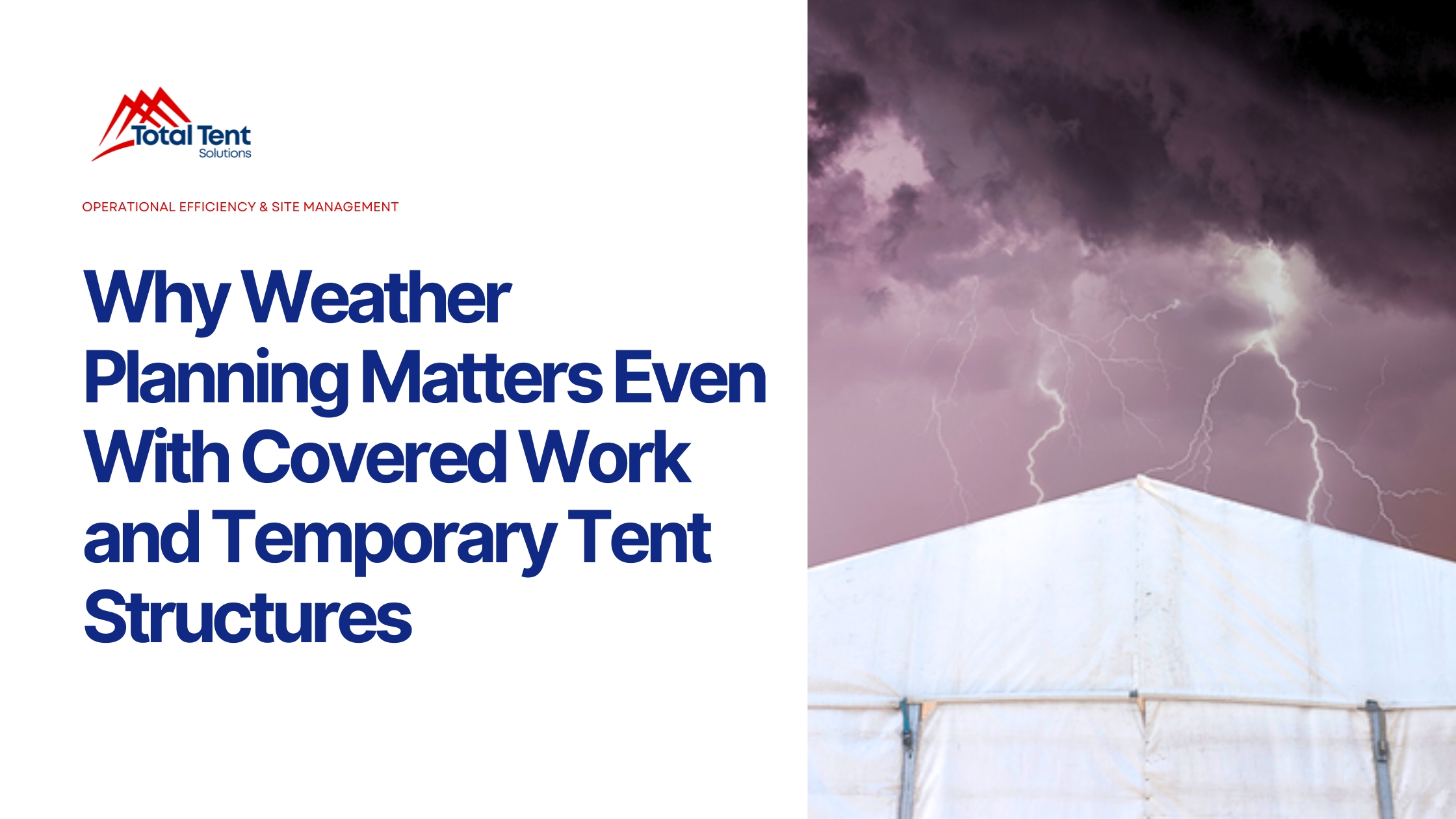
Temporary tent structures do a lot of heavy lifting on industrial jobsites. They keep crews productive, protect equipment, create usable workforce support space, and help projects stay on schedule when outdoor conditions are working against you. On a refinery, petrochemical plant, manufacturing site, or turnaround project, that kind of covered work area can be the difference between steady progress and a long list of weather-related delays.
But here is the part that sometimes gets overlooked. Covered work is not the same thing as weather-proof work.
A temporary structure can give your team a controlled, functional, and safer work environment, but it does not erase weather from the jobsite. Wind still matters. Rain still matters. Lightning still matters. Heat, humidity, cold snaps, drainage, anchoring, access roads, and site-specific hazards still matter. The structure is part of the weather plan, not a replacement for it.
That distinction is important, especially for industrial buyers who are not just renting a tent for convenience. They are trying to protect a schedule, support contractors, stage equipment, maintain production, or keep crews working during a planned outage. When the project is tied to a refinery turnaround, plant maintenance window, warehouse overflow need, or critical equipment storage requirement, weather planning becomes operational planning.
Covered Work Is Not the Same as Weather-Proof Work
A clear span temporary structure gives your site a major advantage. It creates a large, open, usable space without interior columns getting in the way. That makes it ideal for contractor staging, maintenance work, lunch areas, tool rooms, equipment storage, warehouse overflow, and other industrial applications where every square foot needs to work hard.
But even with a covered work area, the surrounding environment still plays a role. The structure sits on a real site with real soil conditions, real drainage patterns, real access constraints, and real exposure to wind, rain, heat, and storms. If the planning stops at “we have a roof over it,” the site can still run into problems.
Think of a temporary building like a strong umbrella on a stormy day. It helps, a lot. But if you stand in the wrong place, ignore the wind, or forget that water runs downhill, you are still going to get wet. The same idea applies to industrial temporary structures. The building is valuable, but it works best when it is paired with smart weather planning.
Temporary Structures Reduce Exposure, But They Do Not Remove Weather Risk
Temporary structures are designed to reduce exposure. They help protect people, materials, tools, and work areas from direct sun, rain, and other conditions that can slow a project down. In many cases, they also help create more predictable working conditions, especially when climate control, lighting, flooring, doors, or access points are added.
But weather can still affect how the structure is used. Heavy rain can create muddy access areas. High winds can affect doors, openings, loose materials, and nearby unsecured equipment. Lightning can require work stoppages. Heat can build up inside poorly planned spaces. Cold weather can create condensation or comfort problems if heating and ventilation are not considered.
That is why the question should not be, “Do we have a temporary structure?” The better question is, “Have we planned the structure around the weather conditions this site is likely to face?”
Why Industrial Jobsites Need a Different Level of Planning
A backyard event tent and an industrial clear span structure are not the same thing. They should not be planned the same way, installed the same way, or managed with the same assumptions.
Industrial sites come with higher stakes. A refinery or petrochemical turnaround might involve hundreds of contractors, tight permit windows, security requirements, TWIC access, HASC safety expectations, heavy equipment movement, and nonstop coordination between operations, safety, maintenance, and procurement teams. A temporary structure on that kind of site is not just a covered area. It is an operational support structure.
That means the planning needs to match the environment. Site conditions, wind exposure, anchoring requirements, ingress and egress, weather monitoring, emergency procedures, crew certifications, and code considerations all need to be part of the conversation before installation begins.
The Real Role of a Temporary Structure on an Industrial Site
For industrial buyers, temporary structures are rarely just about comfort. They are about keeping work moving when conditions are unpredictable.
A plant may need a temporary building for warehouse overflow during peak inventory. A refinery may need a clear span structure for contractor staging during a turnaround. A manufacturing facility may need an industrial enclosure to protect sensitive equipment. A petrochemical site may need a climate-controlled workforce support space during summer maintenance.
In each case, the structure supports a bigger goal. It protects time, labor, materials, and operational continuity.
Jobsite Protection for Crews, Equipment, and Production Schedules
Weather delays do not just affect the task happening at that moment. They ripple through the entire project. One delayed crew can push another crew out of sequence. Wet materials can create rework. Heat stress can slow productivity. Poor access conditions can delay deliveries. A storm that was not planned for can turn a clean staging area into a problem zone.
Temporary structures help reduce those risks by giving crews and materials a more controlled place to operate. When properly planned, they can support welding prep, mechanical work, electrical staging, tool storage, parts organization, break areas, lunch tents, and equipment protection.
The value is not just that people are covered. The value is that the work has a better chance of staying organized, accessible, and on schedule.
Clear Span Structures for Turnarounds, Maintenance, and Contractor Staging
Clear span structures are especially valuable for industrial work because they provide wide-open interior space. There are no interior support poles interrupting workflow, which makes them useful for forklift movement, pallet storage, equipment staging, temporary warehousing, and large crew movement.
During a turnaround, that flexibility matters. Contractors need room to organize tools, parts, PPE, consumables, and specialty equipment. Supervisors need predictable locations for crews to gather and receive instructions. Procurement teams need temporary inventory areas that keep materials dry and accessible. Safety teams need a space that supports orderly movement instead of creating bottlenecks.
A well-planned temporary structure becomes part of the project’s rhythm. It gives the site a place to breathe.
Exclusion: Not Every Covered Area Is Designed for Industrial Use
It is important to be clear here. Not every tent or covered space belongs on an industrial jobsite.
Some products are built for light-duty events, backyard use, or short-term retail applications. That is not the same as a temporary building designed for industrial use. Refinery, petrochemical, manufacturing, and maintenance environments require stronger planning, better coordination, and crews who understand plant access, safety expectations, and the pace of industrial work.
For industrial applications, the structure should be matched to the job, the site, and the weather exposure. The installation crew should understand the environment. The anchoring plan should make sense for the surface. The layout should support operations. The structure should be engineered to code where required.
This is where experienced providers separate themselves from basic rental vendors.
Weather Planning Starts Before the Structure Arrives
The best weather planning happens before the first truck shows up.
By the time a temporary structure is being installed, many key decisions have already been made. Location, orientation, access routes, drainage, anchoring method, door placement, flooring, lighting, HVAC, and utility needs all affect how well that structure will perform when weather shows up.
If those details are rushed, the site may still get a usable structure, but it may not get the best possible solution. And on an industrial site, “good enough” can become expensive fast.
Site Access, Drainage, Anchoring, and Utility Coordination
Weather planning should start with the ground. Is the location level? Does water drain away from the structure or toward it? Will forklifts need to enter? Will crews be walking in and out all day? Are there low spots where rainwater collects? Is the surface asphalt, concrete, gravel, soil, or a mix of conditions?
These details matter because rain does not care that the work area is covered. If water runs through the access path or pools around entry points, workers may still deal with mud, slips, delays, and material handling issues.
Anchoring is another key piece. Different sites require different anchoring solutions. A structure installed on concrete may require a different approach than one installed on compacted aggregate or open ground. Wind exposure, structure size, surface type, and site restrictions all influence the plan.
Then come the utilities. Climate control, lighting, power, doors, and ventilation all need to be thought through early. A climate-controlled temporary structure is only effective if the power, layout, air movement, and access points are planned correctly.
Why Plant-Ready Crews Matter on Refinery and Petrochemical Sites
On industrial sites, the crew matters as much as the structure.
Refineries and petrochemical facilities are not places where unprepared crews can simply show up and figure it out. Access requirements, safety orientations, PPE rules, site communication, work permits, and security procedures all affect the installation timeline.
That is why plant-ready crews are so important. TWIC/HASC certified crews bring a different level of readiness to the job. They understand that the work is happening inside a controlled, safety-focused environment where delays can affect more than one department.
A temporary structure partner that understands industrial sites can coordinate more effectively with operations, maintenance, safety, and procurement. That helps the installation go smoother and reduces friction before the weather ever becomes a factor.
Wind Is Usually the First Weather Risk to Plan Around
Wind deserves serious attention on any temporary structure project. Even when skies are clear, wind can create challenges for temporary buildings, doors, panels, anchoring systems, loose materials, and nearby equipment.
The larger the structure, the more important wind planning becomes. A clear span structure has a big surface area. That is part of what makes it useful, but it also means the installation needs to be planned with wind exposure in mind.
Why Engineered Temporary Buildings Matter
Industrial buyers should be asking whether the temporary building is appropriate for the site and application. That includes questions about engineering, code requirements, wind ratings, anchoring, and installation methods.
An engineered temporary structure is not just about checking a box. It is about making sure the structure is suited for the environment where it will be used. Local conditions, exposure, soil or surface type, nearby buildings, duration of use, and operational needs all matter.
For a petrochemical turnaround or refinery maintenance project, the structure may be supporting hundreds of people or protecting valuable equipment. In that context, engineering and planning are not extras. They are part of responsible project execution.
Anchoring, Orientation, and Clear Span Performance
Wind planning includes more than the structure itself. Orientation can matter. Door placement can matter. The surrounding environment can matter. An open side facing prevailing winds may create more operational problems than expected. A poorly secured access point can become a weak spot. Loose materials around the structure can become hazards.
Anchoring should be matched to the site, not guessed. This is especially important when the temporary structure is installed on a refinery pad, plant yard, parking area, laydown yard, or space with underground utilities and restrictions.
The goal is not just to keep the structure standing. The goal is to keep the work area functional, safe, and aligned with the jobsite’s operating plan.
Rain Can Still Slow Down Covered Work
Rain is one of the main reasons companies use temporary structures in the first place. Covered work areas help crews keep moving when rain would otherwise shut down tasks, damage materials, or create difficult working conditions.
But rain planning still matters.
A roof keeps direct rainfall off the work area. It does not automatically solve drainage, access, humidity, mud, runoff, or material movement. Those details need to be planned into the layout.
Drainage, Mud, Material Handling, and Worker Movement
If the structure is placed in a low spot, rain can still create problems around the perimeter. If forklifts are moving in and out, the access path needs to support that traffic after bad weather. If crews are walking between the structure and the main work area, the route needs to stay safe and usable.
Mud is more than an inconvenience. It slows movement, creates housekeeping issues, increases slip potential, and can make equipment handling harder. In some cases, poor drainage can also affect the usability of stored materials or create problems at entry points.
That is why drainage should be part of the site walk. The structure should be placed where it supports workflow and weather resilience.
Keeping Maintenance and Turnaround Projects Moving
During maintenance or turnaround work, rain delays can quickly become schedule issues. A temporary structure helps by creating a dry area for staging, prep work, crew support, and material storage.
For example, a contractor staging area can keep tools and consumables organized. A temporary warehouse can protect parts waiting to be installed. A workforce support space can give crews a reliable place to gather, eat, cool down, or reset between tasks.
The more critical the schedule, the more important the planning. A covered work area should be positioned and outfitted to support the flow of the job, not just placed wherever space is available.
Lightning Risk Does Not Disappear Under a Tent
This is one of the biggest misconceptions around covered work.
A temporary structure may reduce exposure to rain and sun, but lightning safety still requires a formal plan. Workers should not assume that being under a temporary structure means lightning risk has been handled. Jobsite leaders need clear procedures for monitoring storms, stopping work, moving crews, and resuming work safely.
Covered Work Still Needs a Storm Protocol
Every site should have a weather protocol that answers practical questions. Who monitors weather? Who has authority to stop work? Where do crews go during lightning? How is the message communicated? When can work resume? What happens to equipment, open doors, tools, and materials before a storm arrives?
These decisions should not be made during the storm. By then, the jobsite is already reacting.
A temporary structure can be part of the plan, but it should not be treated as the entire plan. Industrial sites need defined storm procedures that align with the facility’s safety rules.
Why Supervisors Need Clear Stop-Work Triggers
Supervisors should not have to guess when to stop work. Weather planning works best when triggers are clear. Thunder, lightning, high wind alerts, severe storm warnings, heat index thresholds, or site-specific safety rules can all be used to guide decisions.
Clear triggers reduce confusion. They also make it easier for contractors, maintenance teams, and plant leaders to stay aligned. Everyone knows what happens, when it happens, and who makes the call.
That kind of clarity is especially valuable during refinery and petrochemical work, where multiple contractors may be operating under tight timelines.
Heat and Humidity Are Productivity Risks, Not Just Comfort Issues
In Gulf Coast industrial environments, heat and humidity are not minor annoyances. They are major planning factors.
A covered structure can reduce direct sun exposure, but heat can still build up. Humidity can still make work uncomfortable. Crews can still slow down. Materials and equipment can still be affected. If the goal is to support productive work through summer conditions, climate control may need to be part of the plan.
Climate-Controlled Temporary Structures for Gulf Coast Worksites
Climate-controlled temporary structures are especially valuable for refineries, petrochemical plants, manufacturing facilities, and industrial maintenance sites that operate through hot, humid months.
Adding HVAC can turn a basic covered area into a more useful workforce support space. Crews can recover more effectively. Supervisors can hold meetings in a more controlled environment. Sensitive materials may be easier to manage. Break areas, lunch tents, and staging areas become more functional.
The key is planning the climate control properly. Structure size, insulation, door usage, power availability, air distribution, and occupancy all affect performance. A large industrial enclosure with constant forklift traffic will have different needs than a smaller crew support structure.
Workforce Support Space That Helps Crews Stay Productive
When crews are working long shifts during a turnaround or maintenance event, small improvements in working conditions can have a big effect. A climate-controlled workforce support space gives people a place to cool down, hydrate, eat, meet, and reset.
That matters because productivity is not just about pushing harder. It is about creating conditions where crews can keep working safely and steadily.
Temporary structures help support that rhythm. They give the jobsite a controlled base of operations in the middle of a demanding environment.
Cold Weather Planning Still Matters for Covered Work
Cold weather brings its own challenges. Depending on the location and time of year, industrial sites may need heated temporary buildings, enclosed work areas, protected storage, or conditioned spaces for crews.
Even if snow and ice are not common in every service area, cold snaps can still affect productivity, comfort, condensation, equipment performance, and material handling.
Heating, Condensation, Flooring, and Access Points
Heating a temporary structure is not just about placing warm air inside. The full environment needs to be considered. How often will doors open? Are forklifts entering and exiting? Is the flooring appropriate? Will condensation become an issue? Are crews moving between heated and unheated areas?
Poor planning can create uneven temperatures, moisture issues, or slippery entry points. Strong planning helps the temporary building function more like a true operational support space.
Protecting Materials, Tools, and Equipment Storage Areas
Cold and wet conditions can affect more than people. Tools, parts, packaging, and equipment may need protection from moisture or temperature swings. A temporary building can help protect those materials, but only if the interior layout and access plan support the way the site actually works.
Equipment storage areas should be easy to access, organized, and protected from unnecessary exposure. If the structure is serving as warehouse overflow, the layout should support inventory movement, forklift paths, and safe loading practices.
Weather Planning Protects More Than the Structure
A common mistake is thinking weather planning is only about protecting the temporary structure itself. In reality, the structure is just one piece of the jobsite ecosystem.
Weather planning protects people. It protects equipment. It protects materials. It protects access routes. It protects the schedule. It protects the budget. And in industrial settings, it helps protect the broader operation from unnecessary disruption.
People, Equipment, Inventory, and Timelines
When weather hits a poorly planned site, everything becomes harder. Workers lose time. Supervisors scramble. Equipment gets moved in a hurry. Materials may need to be rechecked, dried, replaced, or reorganized. Tasks that should have been simple become slow and messy.
A temporary structure gives the site a major advantage, but only when it is integrated into the overall work plan. Where will crews gather? Where will materials be staged? Where will forklifts enter? Where will water go? What happens when winds pick up? How will work pause and restart?
These practical questions turn a structure into a strategy.
Why Temporary Buildings Support Operational Continuity
Industrial companies invest in temporary buildings because downtime is expensive. When a plant is in a planned maintenance window, time is limited. When inventory exceeds warehouse capacity, space matters. When contractors need staging areas, organization matters. When crews are working in heat, rain, or cold, conditions matter.
Temporary structures help companies maintain continuity. They create usable space where and when it is needed. Weather planning makes that space more dependable.
The Cost of Poor Weather Planning
Poor weather planning usually shows up in the form of friction. At first, it may not look dramatic. A muddy entrance. A delayed delivery. A hot lunch tent. A door facing the wrong direction. Water pooling near stored materials. Crews unsure where to go during lightning. Loose items left outside before high winds.
But those small issues add up.
Delays, Rework, Safety Exposure, and Production Disruption
Weather-related problems can lead to delays, rework, damaged materials, safety concerns, and lower productivity. On a small job, that is frustrating. On a refinery, petrochemical, manufacturing, or industrial maintenance site, it can become a serious operational issue.
A delayed turnaround task can affect other trades. A poorly protected staging area can slow installation work. A hot, uncomfortable workforce support space can reduce the value of the rental. A missed storm protocol can create confusion at the worst possible time.
The structure may still be standing, but the jobsite may not be performing the way it should.
Why Planning Beats Reaction Every Time
Reaction is expensive. Planning is cheaper.
When weather planning happens early, the team can make better choices. The structure can be placed in a smarter location. The anchoring method can match the site. The access routes can be considered. Climate control can be sized appropriately. Storm protocols can be communicated. Crews can understand what to do before weather becomes a problem.
Good planning does not guarantee perfect conditions. It simply gives the jobsite a better chance of staying safe, organized, and productive.
What Strong Weather Planning Looks Like
Strong weather planning is practical. It does not need to be complicated, but it does need to be intentional.
It starts with understanding the jobsite, the work being performed, the expected weather conditions, and the role the temporary structure needs to play. Then it turns that information into decisions about layout, anchoring, access, drainage, utilities, climate control, and communication.
Pre-Installation Review
A pre-installation review should look at the structure location, ground conditions, drainage, access routes, nearby hazards, anchoring options, power needs, and operational flow.
For industrial sites, it should also account for safety requirements, security access, work permits, and coordination with plant personnel. This is especially important when working inside refineries, petrochemical facilities, and other controlled environments.
The goal is to identify problems before they become field issues.
Daily Weather Monitoring
Weather planning does not stop after installation. Conditions can change quickly. Site leaders should monitor daily forecasts, wind conditions, lightning risk, rain, heat index, and severe weather alerts.
For longer rentals, this becomes even more important. A structure used for warehouse overflow, equipment storage, or contractor staging may be in place for weeks or months. The weather plan should remain active the entire time.
Communication Between Site Leaders and Structure Crews
Communication is what makes the plan work. The rental provider, site safety team, project manager, and operations leaders should understand the structure’s intended use and any weather-related procedures.
If high winds are expected, who checks the structure? If severe weather is approaching, who secures doors or loose materials? If work needs to pause, who communicates that to crews? If the site needs service or adjustment, who is the point of contact?
These details may sound simple, but they make a major difference when the weather changes fast.
Choosing the Right Temporary Structure Partner
The right partner should understand that industrial temporary structures are not just products. They are jobsite solutions.
A strong partner will ask about the application, site conditions, schedule, weather exposure, access requirements, anchoring needs, and safety expectations. They will understand the difference between a general rental and an industrial enclosure built to support real work.
Industrial Experience Matters
Industrial experience matters because these projects move differently. A refinery turnaround does not operate like a wedding setup. A petrochemical maintenance project does not operate like a festival. A manufacturing warehouse overflow need does not operate like a weekend event.
Industrial sites require stronger coordination, better safety awareness, and a deeper understanding of operational pressure.
Look for a provider that is comfortable supporting turnaround tents, clear span structures, climate-controlled temporary buildings, contractor staging areas, lunch tents, equipment storage, and plant maintenance projects.
TWIC/HASC Certified Crews and Code-Aware Installation
For refinery and petrochemical work, crew readiness is a major factor. TWIC/HASC certified crews can help reduce access issues and support a smoother installation process. That matters when the project is tied to a tight schedule or a planned outage window.
Code-aware installation also matters. Temporary structures should be planned with appropriate engineering, anchoring, and site-specific requirements in mind. The goal is not just to install something quickly. The goal is to install the right structure, in the right way, for the conditions it will face.
Conclusion
Weather planning still matters, even when the work is covered. A temporary structure, clear span structure, or industrial enclosure can dramatically improve jobsite protection, crew productivity, equipment storage, and schedule control. But the structure is only one part of the plan.
Wind, rain, lightning, heat, humidity, cold, drainage, access, anchoring, and site safety all need to be considered. That is especially true on refinery, petrochemical, manufacturing, and turnaround projects where delays are costly and coordination is critical.
The smartest approach is simple. Treat the temporary building as an operational support structure, not just a covered space. Plan it around the jobsite, the weather, the crews, and the schedule. When you do that, the structure becomes more than a place to work. It becomes a tool for keeping the entire project moving.
FAQs
1. Does a temporary tent structure eliminate weather delays?
No. A temporary tent structure can reduce weather-related delays, but it does not eliminate weather risk completely. Wind, lightning, drainage, heat, cold, and access conditions still need to be planned for. The structure helps create a more controlled work area, but the jobsite still needs a weather plan.
2. Why is wind planning important for temporary structures?
Wind affects the structure, anchoring system, doors, openings, nearby loose materials, and overall jobsite safety. Industrial temporary buildings should be planned around site exposure, surface conditions, anchoring requirements, and local weather expectations. This is especially important for clear span structures with large surface areas.
3. Can temporary structures be climate controlled?
Yes. Many industrial temporary structures can be climate controlled with HVAC, heating, ventilation, and other support systems. This is especially useful for Gulf Coast refineries, petrochemical sites, manufacturing facilities, and turnaround projects where heat and humidity can affect crew productivity.
4. Are all tents suitable for refinery or petrochemical sites?
No. Industrial sites require a higher level of planning, safety awareness, and installation experience. Refinery and petrochemical environments often require plant-ready crews, TWIC/HASC certifications, proper anchoring, code-aware planning, and coordination with site safety and operations teams.
5. What should be considered before installing a temporary structure on an industrial jobsite?
Key considerations include the purpose of the structure, site access, drainage, anchoring, surface type, wind exposure, utility needs, climate control, door placement, forklift movement, emergency procedures, and crew certification requirements. A pre-installation review helps make sure the temporary building supports the work instead of creating new problems.