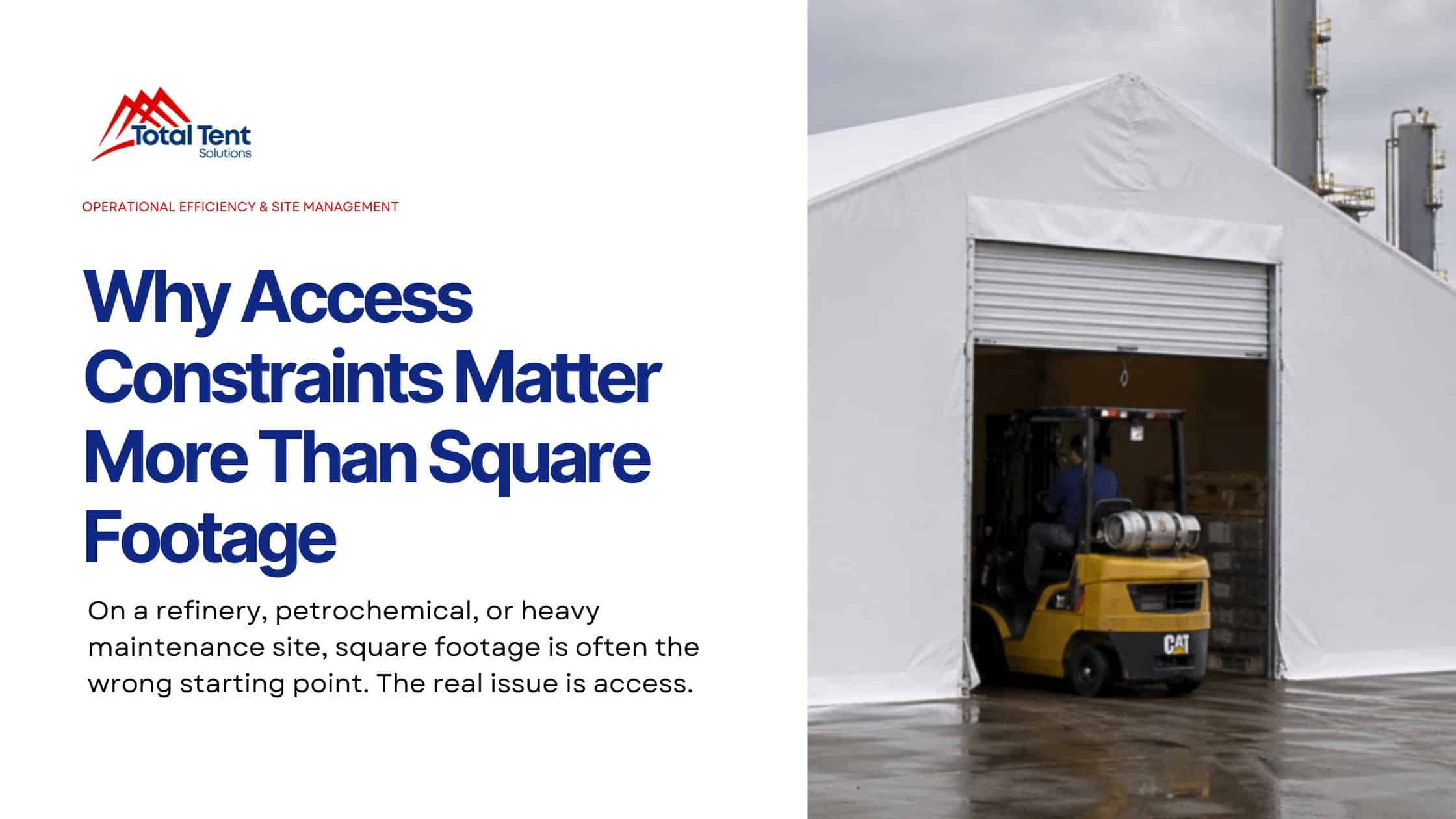
If you are planning a temporary structure for an industrial job site, it is tempting to start with one question. How many square feet do we need?
Seems logical, right? Bigger job, bigger footprint. More workers, more space. More equipment, more room. On paper, that sounds clean and simple.
But industrial projects are rarely clean and simple.
On a refinery, petrochemical, or heavy maintenance site, square footage is often the wrong starting point. The real issue is access. Can materials get in? Can plant-ready crews install safely? Can cranes reach the work zone? Can the structure fit around existing equipment, overhead obstructions, contractor staging needs, and active operations without turning the site into a bottleneck?
That is why access constraints matter more than square footage. A temporary building that looks perfect on a layout can become a scheduling problem the moment it meets a live industrial site. OSHA guidance stresses controlled access and egress, vehicle routing, separation of pedestrians from equipment paths, and planning for staging, rest areas, and worker movement before work begins. In other words, access is not a side issue. It is part of the jobsite plan itself.
The Common Mistake Buyers Make
Why square footage feels like the obvious starting point
Square footage is easy to talk about because it feels measurable. It gives purchasing teams, operations leaders, and project managers a quick way to compare options. One temporary structure is 40 by 80. Another is 60 by 120. One seems clearly larger, so it seems clearly better.
That works fine if you are comparing empty lots.
Industrial job sites are not empty lots. They are more like trying to move a couch through a crowded hallway. The couch may fit in the room, but if it cannot get through the door, around the corner, and past the stairs, the room size does not matter. The same thing happens with a clear span structure on an active plant site.
Why industrial job sites do not work like open commercial lots
Industrial sites are full of friction points. Entry gates may be tight. Truck access may be controlled. Laydown areas may be limited. Existing infrastructure may block crane positioning. Active maintenance zones may shrink the usable install window. Even worker break areas and restrooms must be located so crews can access them without crossing vehicle conflict points, according to OSHA traffic control guidance.
That means the real question is not just, “How much space do we want?” It is, “How much space can we safely install, access, and use without disrupting operations?”
What Access Constraints Actually Mean
Site entry and gate limitations
Access starts before the temporary building ever reaches the pad. Can delivery vehicles enter through the gate? Are there turning-radius issues? Can oversized components get through security checkpoints or around permanent structures? If a site has narrow internal roads, traffic restrictions, or tightly controlled entry windows, the install plan is already under pressure.
OSHA guidance on work-zone access emphasizes that routes should be planned before vehicles arrive, access and egress locations should be designated, and vehicle movements should be controlled to reduce risk. That principle carries over directly to industrial temporary structures.
Laydown space and staging restrictions
A structure is not installed out of thin air. Materials need a place to land, be sorted, and be assembled. If the site has little or no laydown area, the footprint of the structure is only part of the equation. You also need room for deliveries, crew staging, rigging, and installation sequencing.
This is especially true during refinery turnarounds and petrochemical maintenance events, where contractor staging, equipment storage, and temporary workforce support space all compete for the same limited real estate. When too many functions pile into the same area, the site gets congested fast, and congestion is not just inconvenient. It can create safety exposure and schedule drag. OSHA notes that work in tight and congested areas increases risk and makes housekeeping and hazard control more critical.
Crane reach, swing radius, and equipment movement
This is where many layouts fall apart. A temporary building may technically fit the chosen footprint, but not if the crane cannot set components from a safe position. Nearby process units, tanks, pipe racks, utility corridors, and active traffic lanes can all restrict crane placement and boom movement.
If you have ever watched a great plan crumble because a lift path got blocked, you know the feeling. The footprint still exists on paper, but the real-world installation window vanishes.
Pipe racks, overhead lines, and existing plant infrastructure
Industrial sites are rarely blank slates. Above-ground utilities, process lines, racks, existing buildings, security fencing, and fixed equipment can limit both horizontal and vertical access. OSHA location rules for bulk oxygen systems, for example, require siting that avoids exposure to electric power lines and flammable or combustible lines. That is one specific regulation, but the broader lesson is clear. On industrial sites, location decisions are tied to exposure, clearance, and surrounding infrastructure, not just available ground area.
Why vertical clearance matters as much as footprint
A lot of people underestimate height. They look at a pad and say, “Yes, we can fit the structure here.” But if the peak height conflicts with adjacent equipment, overhead utilities, or plant restrictions, that nice rectangular footprint means very little.
Why obstructions can kill an otherwise perfect layout
A temporary building is like a chess move, not a sticker on a map. You have to think about how it arrives, how it gets erected, how it opens for access, and how crews and equipment use it after installation. One obstruction in the wrong place can ruin the whole sequence.
Why Refinery and Petrochemical Sites Change the Conversation
Turnaround work is driven by schedule, not theory
In refinery and petrochemical environments, the clock is brutal. Turnarounds, shutdowns, and major maintenance windows are expensive, tightly scheduled, and often layered with multiple contractors. Nobody cares that a structure looked efficient in a proposal if it burns half a day because access was misread.
That is why industrial intent needs to be loud in the way these structures are planned and marketed. The real buyer is not browsing for a generic tent. They are looking for a temporary structure, industrial enclosure, or operational support structure that fits refinery maintenance, contractor staging, warehouse overflow, equipment storage, or workforce support space in a live plant setting.
Contractor staging areas must support real workflow
Contractor staging is not just about having a roof over a group of people. It is about supporting workflow. Workers need safe access. Materials need flow. Supervisors need visibility. Equipment needs room to move. Break areas, storage zones, and maintenance support spaces need to work together instead of competing with each other.
OSHA specifically calls for planning safe locations for worker parking, access to the work area, and placement of rest areas and water so people do not have to cross vehicle paths unnecessarily. That is a direct reminder that support space must be designed around movement, not just size.
Access planning affects safety, labor efficiency, and uptime
Poor access planning creates small delays that compound. Workers take longer routes. Materials get staged twice. Equipment waits on space. Supervisors improvise. Crews bunch up. Deliveries bottleneck. Nobody writes those problems into the brochure, but they show up in field performance.
Square Footage Without Access Is Just a Bad Guess
A large temporary structure that cannot be installed is useless
This sounds obvious, but it is amazing how often projects still start with dimensions before logistics. If you need a 10,000-square-foot temporary building but the site can only support a safe and practical install of 7,500 square feet in that zone, the 10,000-square-foot option is fantasy.
A structure that cannot be delivered, staged, erected, and used efficiently is not a solution. It is just a bigger problem.
A smaller clear span structure with better access often performs better
Sometimes the best answer is a smaller clear span structure that is easier to install and far easier to operate. Clear-span interiors eliminate internal columns that interfere with movement, machinery, storage layout, and handling paths. Legacy notes that clear-span construction supports unobstructed movement of goods, heavy equipment, conveyors, cranes, and catwalks, which is exactly the kind of operational flexibility industrial buyers care about.
The real question is usable operational space
This is the heart of the matter. Buyers should not focus on gross square footage. They should focus on usable operational space. How much of the footprint can actually be used well once access lanes, staging zones, door placement, equipment circulation, and safety buffers are accounted for?
That number is what matters.
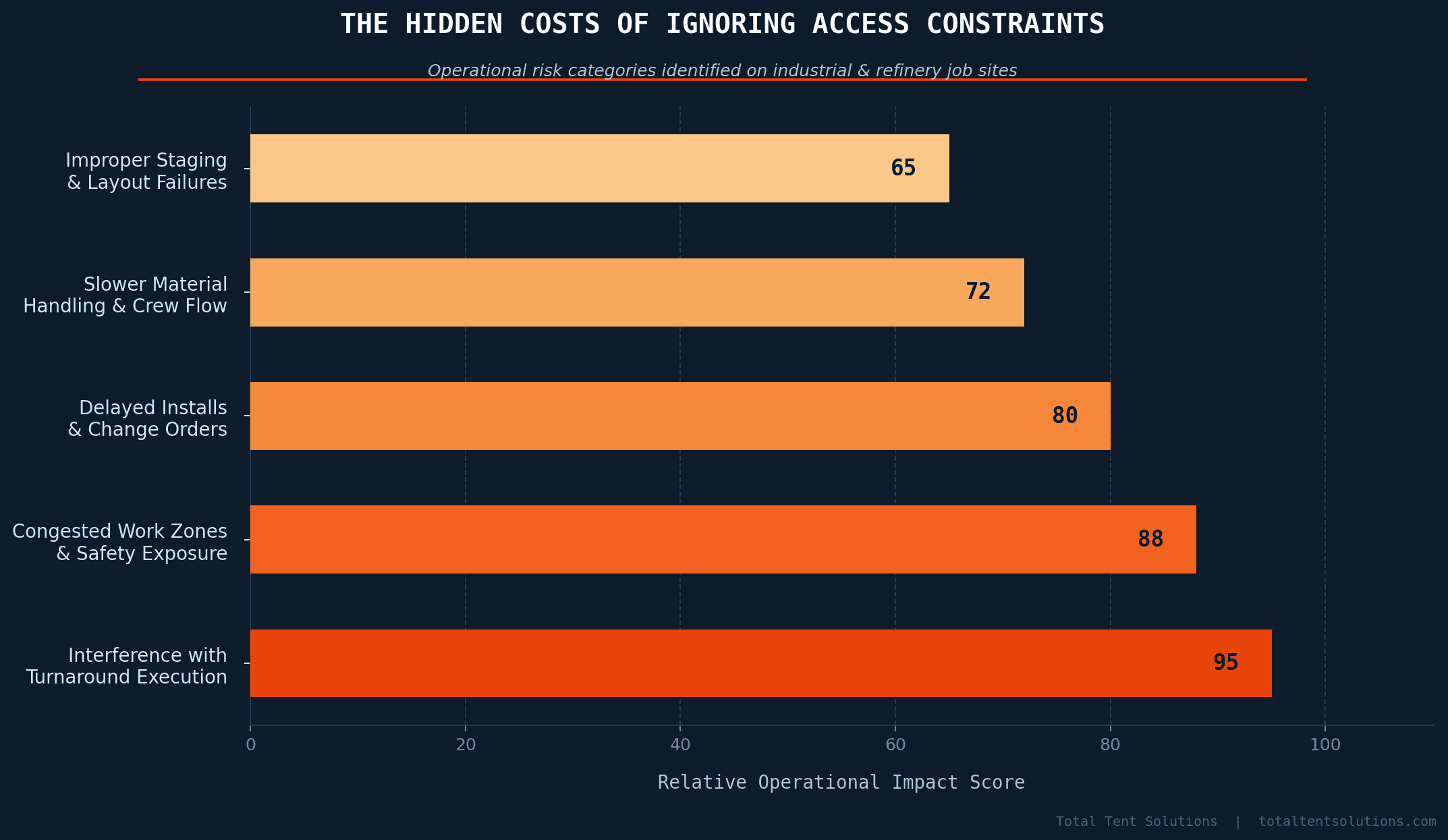
The Hidden Costs of Ignoring Access Constraints
Delayed installs and change orders
When access gets misjudged, crews start solving problems in the field. That usually means resequencing deliveries, changing layout, shrinking footprint, moving openings, or reworking staging plans. None of that is free.
Congested work zones and safety exposure
OSHA’s guidance on congested work areas and traffic control makes a simple point. Tight spaces increase risk when people, vehicles, and materials are forced into the same paths. Access planning helps isolate pedestrians, limit vehicle access points, and coordinate movement. Ignore it, and the site gets messy fast.
Slower material handling and crew movement
Every extra step costs time. Every awkward turn with a forklift costs time. Every blocked opening costs time. On industrial sites, time leaks like air from a slow tire. You may not notice it in the first hour, but by the end of the day, you absolutely feel it.
Interference with maintenance and turnaround execution
This is where bad planning gets expensive. A structure that blocks access to adjacent work fronts, interferes with equipment routes, or creates conflicts with other contractors becomes an obstacle instead of an asset.
The Role of Clear Span Structures on Tight Industrial Sites
Why unobstructed interiors matter
Clear span design matters because internal columns steal flexibility. In industrial applications, unobstructed interiors can improve movement, loading, unloading, storage planning, and equipment handling. Legacy also highlights that clear-span interiors create more usable space and reduce interference with heavy machinery.
How clear span design supports equipment storage and workforce support space
For equipment storage, warehouse overflow, or contractor staging, clear span structures give teams more freedom to arrange the inside around the job instead of around the frame. That can mean better material flow, better door placement, and fewer compromises on how the space is used.
Why engineered temporary buildings fit industrial intent better than generic tents
The industrial buyer is not looking for a party tent with a tougher skin. They need a temporary building or industrial enclosure engineered to code, configured around site constraints, and capable of fitting real-world use cases like maintenance support, lunch tents, warehousing, contractor staging, and equipment storage. Legacy says its buildings are designed to meet or exceed local and international building codes, while Sprung emphasizes rapid deployment, limited foundation requirements, and use across oil and gas applications including warehousing, maintenance facilities, and lunch tents.
What Industrial Buyers Should Evaluate Before Size
Access route for trucks and materials
Start at the gate. Ask how components enter, where they unload, and how they move to the install area.
Installation sequencing and equipment positioning
Ask where cranes, lifts, and crew staging will go. If those answers are fuzzy, the square-foot calculation is premature.
Ground conditions and foundation limitations
Some systems are attractive on industrial sites because they have limited foundation requirements. Sprung specifically notes that its oil and gas structures have limited foundation requirements, which can help on sites where excavation or permanent work is restricted.
Code requirements and plant-specific safety rules
Industrial sites often have stricter siting and safety rules than general commercial projects. Exposure separation, utility conflicts, hazardous-area considerations, and internal safety protocols all matter.
Plant-ready crews and industrial certifications
For refinery and petrochemical work, buyers often care about more than the structure itself. They want plant-ready crews who understand industrial safety expectations. That is where qualifiers like TWIC/HASC certified crews and plant-ready crews strengthen industrial intent and speak to the actual buying environment.
When a Temporary Building Is the Better Fit
Warehouse overflow
A temporary building can make sense when warehouse capacity gets squeezed but permanent construction is too slow or too expensive. Clear-span space helps maximize usable storage and movement.
Maintenance enclosures
For maintenance work, an industrial enclosure can protect crews, tools, and work zones from weather while helping operations stay on schedule.
Contractor staging
For shutdowns and turnarounds, workforce support space can help centralize contractor operations and reduce chaos, assuming access and circulation are planned correctly.
Equipment storage and jobsite protection
Temporary structures can also work well for equipment storage and jobsite protection where fast deployment and flexibility matter. Sprung highlights rapid installation rates and use for warehousing and maintenance facilities in oil and gas contexts.
Exclusion Language That Matters
Not ideal for every site or every use case
It is worth saying clearly: a temporary structure is not the right answer for every industrial project. If the site has severe clearance conflicts, no workable access route, or operating conditions that require a more permanent facility, forcing a temporary option can backfire.
When permanent construction may be the better option
If the use case is long-term, utility-heavy, highly integrated with existing plant systems, or dependent on fixed infrastructure, a permanent building may be a better investment.
When access conditions make relocation or modular phasing smarter
Sometimes the smartest move is not one big structure. It may be phased installation, multiple smaller operational support structures, or a relocatable layout that matches the site’s real-world constraints.
How the Best Providers Think
They start with site logistics
Strong providers do not begin with brochure dimensions. They begin with access, safety, schedule, and workflow.
They design around constraints, not around brochure dimensions
That means looking at gate size, route control, overhead obstructions, staging space, door placement, clearances, and how the structure will actually function once installed.
They treat access as an operational strategy issue
This is the big shift. Access is not just an installation problem. It is an operational strategy issue. It affects safety, labor efficiency, material flow, and schedule performance from day one through demobilization.
Final Takeaway for Industrial Decision-Makers
On industrial job sites, square footage is easy to sell because it is easy to measure. But access is what determines whether the temporary structure actually works.
That is especially true on refinery, petrochemical, and turnaround projects where contractor staging, equipment storage, warehouse overflow, and workforce support space all have to function inside a tight, high-pressure environment. A large footprint may look impressive, but if the site cannot support safe access, proper staging, equipment movement, and efficient workflow, that footprint becomes a liability.
So before asking how big the temporary building should be, ask a better question. How will this structure be delivered, installed, accessed, and used on a live industrial site?
That question gets you closer to the real answer.
FAQs
What is the biggest mistake companies make when planning a tent for an industrial site?
The biggest mistake is starting with square footage instead of site access. A structure can look perfect on paper and still fail in the field if trucks, cranes, crews, and materials cannot move safely and efficiently around the site.
Why is a clear span structure often better for industrial applications?
A clear span structure removes internal columns, which improves usable space and makes movement easier for crews, materials, forklifts, and equipment. That matters a lot for contractor staging, equipment storage, and warehouse overflow.
Are temporary structures a good fit for refinery turnarounds?
They can be, especially for workforce support space, maintenance enclosures, contractor staging, and operational support. But success depends heavily on access planning, staging, and site-specific layout.
When should a company choose a permanent building instead of a temporary building?
A permanent building may make more sense when the use case is long-term, highly utility-dependent, or too constrained for safe temporary installation and operation.
What should buyers ask a structure provider before requesting a quote?
They should ask about gate access, laydown space, crane requirements, installation sequence, ground conditions, code compliance, door placement, and whether the crew is prepared for industrial site conditions. Those answers usually matter more than raw square footage.