Why Site Safety Planning Is Bigger Than PPE and Permits
When people talk about site safety planning, they usually jump straight to the obvious stuff. Hard hats. Safety glasses. Permits. Barricades. Toolbox talks. All of that matters, of course. But let’s be honest. A jobsite can check every one of those boxes and still feel chaotic, exposed, and harder to manage than it should be.
That is usually where the real conversation begins.
A strong safety plan is not just about rules. It is also about environment. It is about where people gather, where crews recover, where supervisors brief teams, where materials wait, where emergency coordination happens, and how the site stays organized when pressure starts rising.
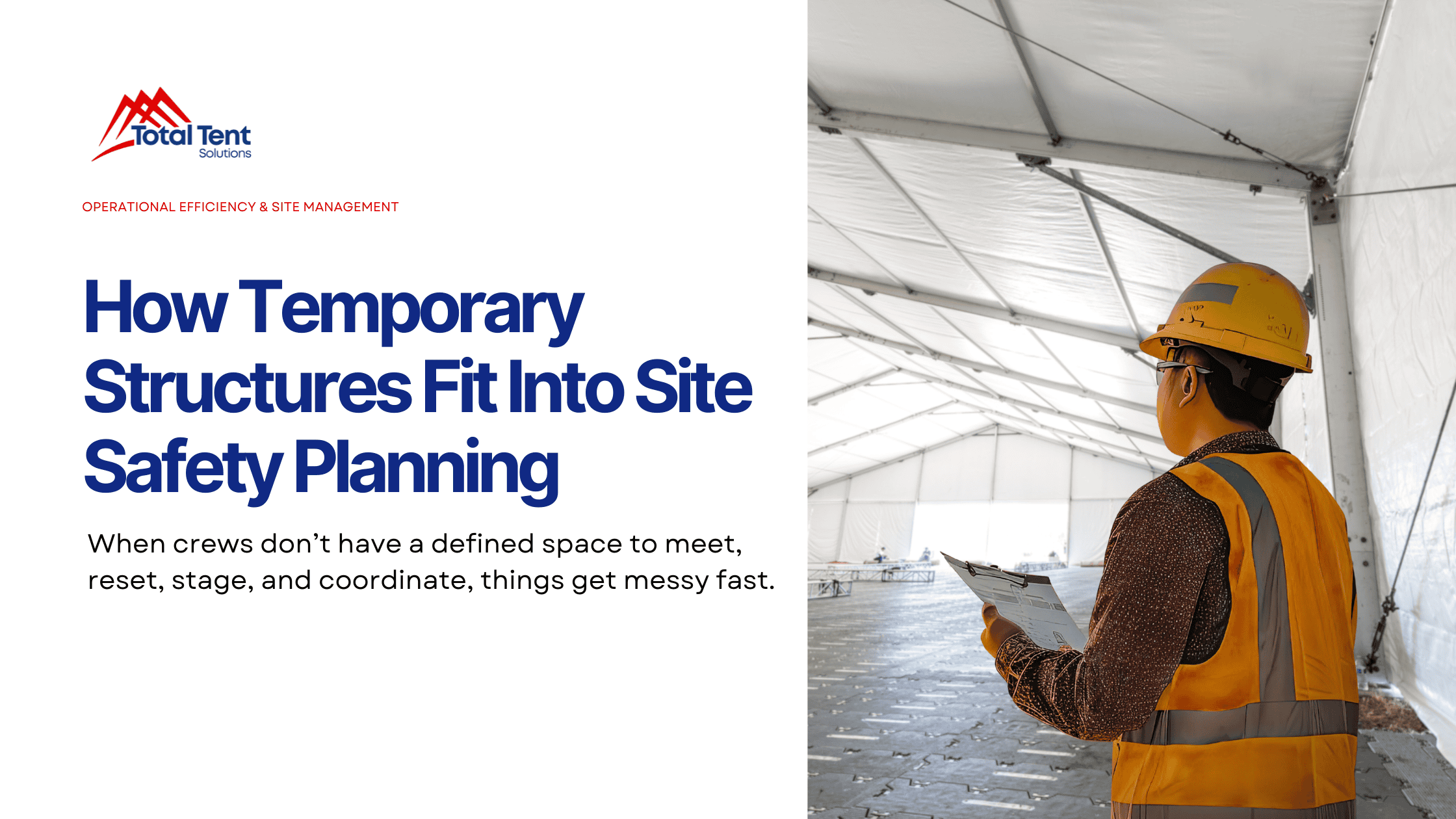
That is why temporary structures belong in the site safety conversation much earlier than they usually do. On refinery, petrochemical, turnaround, and maintenance projects, a clear span structure or temporary building is not just extra square footage. It can be part of the system that reduces exposure, supports workforce movement, improves communication, and helps plant-ready crews operate with less confusion.
What Counts as a Temporary Structure on an Industrial Site
For this conversation, we are not talking about a casual event tent or a vague covered area. We are talking about industrial-use space with a clear purpose.
That can include a clear span structure for contractor staging, a temporary building for workforce support space, an industrial enclosure around a maintenance activity, or an operational support structure used for safety meetings, equipment storage, permit handling, break areas, or warehouse overflow.
So no, this is not about adding a generic shelter. It is about introducing a controlled, engineered to code temporary structure that serves a specific industrial function inside a broader safety strategy.
Why Refinery and Petrochemical Sites Need More Than Basic Coverage
A refinery or petrochemical site during a turnaround is not a normal jobsite. It is more like an airport during a thunderstorm with every gate suddenly full and every plane still expected to leave on time.
You have compressed timelines, multiple trades, tight coordination windows, higher contractor density, restricted areas, active safety oversight, and a lot of moving pieces that do not forgive disorganization.
That matters because crowded, fast-moving jobsites create friction. Friction leads to delays, confusion, shortcuts, and mistakes.
Temporary structures can pull activity away from live work zones and create cleaner separation between execution space and support space. That separation often improves not only productivity, but also hazard awareness and incident response.
Temporary Structures as Part of Hazard Control
A good site safety plan tries to remove friction before friction becomes a problem.
Temporary structures help with that in a very practical way. They give you designated space for pre-task planning, shift change coordination, paperwork, controlled storage, rehab from heat, and protected crew gathering.
Instead of having people clustered beside active equipment, exposed to traffic, noise, weather, or distractions, you can move those activities into a defined operational support structure.
Think of it like moving a football team off the sideline chaos and into a real locker room. Same team, better environment, better execution.
Supporting Heat Stress Prevention and Weather Readiness
Heat stress is one of the clearest examples of why temporary structures matter.
Picture a turnaround in the Gulf Coast or a summer maintenance outage in the South. Crews are layered up in PPE, walking long distances, and working around hot equipment and humidity.
In that setting, a climate-managed temporary structure is not a luxury. It becomes part of the heat mitigation plan.
That structure can support:
• Hydration stations
• Scheduled cooldown breaks
• Supervisory check-ins
• Crew recovery space
It gives plant-ready crews somewhere to recover without improvising under a pipe rack or inside a truck.
Weather readiness matters too. Rain, cold, and wind can disrupt planning, meetings, and inspections. A clear span structure keeps those functions moving.
Improving Emergency Action Planning
Emergency action plans sound good on paper, but paper is not where emergencies happen.
They happen in noise, motion, confusion, and bad visibility.
A temporary building can serve as a controlled location for:
• Briefings
• Accountability tracking
• Communication boards
• Incident coordination
It is not a substitute for a hardened safe room, and it should never be treated as one. But it absolutely supports emergency readiness when used correctly.
Fire Safety and Code Compliance Considerations
This is where a lot of sites get sloppy. Temporary does not mean optional.
The structure has to be planned like infrastructure, not dropped on site like an afterthought.
You need to think through:
• Placement
• Egress
• Nearby ignition sources
• Temporary heating
• Fire extinguisher access
On refinery and petrochemical sites especially, engineered to code has to mean something. The structure needs to match the real hazard profile of the jobsite.
Sanitation, Hygiene, and Worker Welfare
Worker welfare is not separate from site safety. It is part of it.
Temporary structures make it easier to support:
• Clean break areas
• Handwashing access
• PPE transitions
• Organized rest zones
A workforce support space helps crews reset, stay clean, and maintain discipline throughout the day.
And let’s be real. Morale matters. A clean, organized temporary building goes a long way.
Temporary Structures for Contractor Staging and Material Control
Clutter is one of the biggest hidden risks on an industrial site. Without a defined space, materials, tools, and staging creep into walk paths, vehicle routes, and active work zones.
A clear span structure gives teams a place for:
• Contractor staging
• Warehouse overflow
• Equipment storage
• Consumables and tools
It reduces congestion and makes the site easier to navigate and supervise.
Protecting Safety Meetings, Permits, and Pre-Task Planning
Safety communication gets worse when the environment is bad. Trying to run a pre-task meeting in noise, wind, and chaos rarely works as well as people think it does.
A temporary building creates a better setting for:
• JSAs
• Toolbox talks
• Permit reviews
• Shift handoffs
Same message. Better delivery. Better execution.
Security, Access Control, and Industrial Intent
Industrial sites are not public venues.
Temporary structures can support:
• Controlled entry points
• Badging and access checks
• Contractor staging discipline
Using language like contractor staging, plant-ready crews, warehouse overflow, and operational support structure makes the intent clear.
This is built for industrial operations, not general use.
Common Mistakes When Temporary Structures Are Left Out of the Plan
The first mistake is timing. Waiting until the site is already crowded limits your options.
The second mistake is treating the structure like a convenience instead of infrastructure.
The third mistake is assuming any structure will work anywhere. It will not.
Every site has different requirements, hazards, and constraints.
Where Temporary Structures Do Not Belong
Temporary structures are not for every footprint or process area.
They should not be placed:
• In exclusion zones
• Where they block egress
• Near high-risk hazards without planning
They also should not be marketed or treated as safe rooms unless they are designed for that purpose.
Knowing where not to place a structure is just as important as knowing where to place one.
How to Evaluate the Right Structure for the Job
The right temporary structure starts with the real use case.
You need to consider:
• Occupancy
• Duration
• Weather exposure
• Site hazards
• Access routes
• Utility needs
Then comes engineering. Anchoring, layout, and compliance all matter. The more demanding the site, the less room there is for guesswork.
Temporary Structures as a Safety Strategy, Not a Rental Afterthought
At the end of the day, site safety is about control. Control of people, movement, exposure, communication, and coordination.
A temporary structure supports all of that when it is planned correctly. It stops being extra space and starts becoming operational support. That is the difference.
Conclusion
Temporary structures belong in site safety planning because safe jobsites do not happen by accident. They are designed.
On refinery, petrochemical, turnaround, and maintenance projects, the right temporary building can support heat mitigation, emergency planning, sanitation, communication, material control, and workforce flow.
When it is engineered to code, placed intentionally, and integrated into the safety strategy from the beginning, it becomes far more than a convenience. It becomes part of how the site stays organized, compliant, and ready to work.
FAQs
1. Are temporary structures part of safety planning or just operational support?
They are part of safety planning when they support heat mitigation, emergency coordination, sanitation, and controlled staging.
2. Can a temporary structure be used as a safe room?
No. Unless specifically engineered for that purpose, it should not be treated as a hardened safe room.
3. Why are clear span structures useful during turnarounds?
They help reduce congestion, improve coordination, and create controlled space for staging and support functions.
4. Do temporary structures need to meet code requirements?
Yes. Temporary does not mean unregulated. Code compliance still applies.
5. What should be evaluated before choosing a temporary structure?
Use case, occupancy, duration, hazards, access, utilities, and engineering requirements should all be considered.