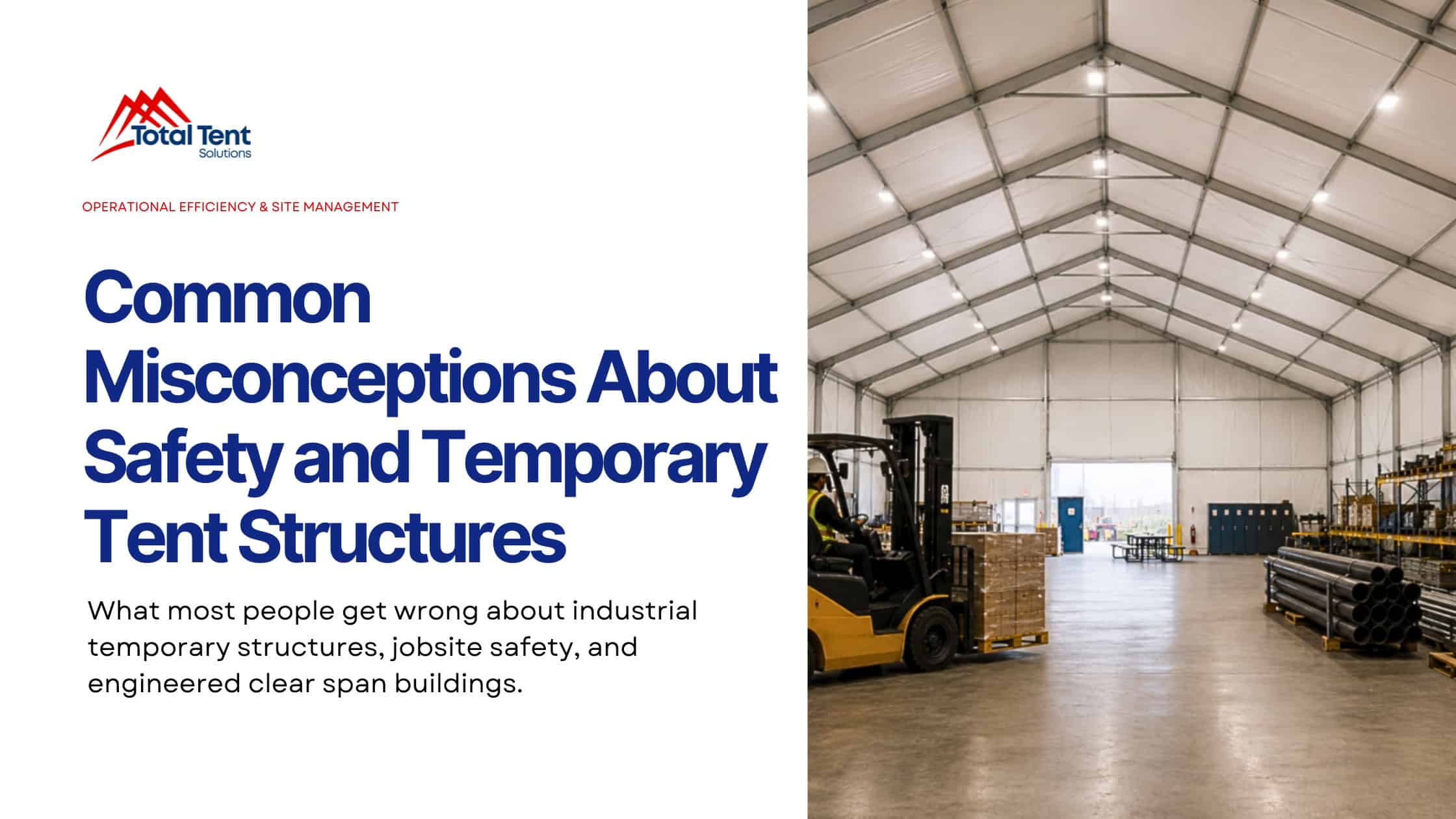
Temporary tent structures have come a long way from what many people picture when they hear the word “tent.” In industrial environments, we are not talking about party rentals, backyard canopies, or lightweight pop-up covers. We are talking about engineered temporary structures, clear span structures, temporary buildings, industrial enclosures, workforce support spaces, jobsite protection, and operational support structures built for demanding work environments.
That distinction matters.
On a refinery, petrochemical plant, manufacturing site, turnaround project, maintenance outage, or construction jobsite, safety is not a nice extra. It is the foundation. The structure has to support the work, protect crews, fit the site, handle environmental loads, and meet the expectations of the authority having jurisdiction, often called the AHJ. Temporary structures may be temporary in duration, but that does not mean temporary in responsibility.
Many safety concerns around temporary tent structures come from outdated assumptions. People hear “tent” and think flimsy. They imagine something that blows around in a storm, leaks in the rain, or becomes unsafe when the jobsite gets complicated. In reality, properly specified industrial temporary structures are designed, installed, anchored, inspected, and maintained with serious operational intent.
Codes and standards recognize temporary structures as real structures that may require compliance with structural strength, fire safety, means of egress, accessibility, ventilation, and other life safety considerations. NFPA 102 also addresses fire and life safety requirements for tents and membrane structures.
So let’s clear the air.
Why Safety Misunderstandings Happen in Industrial Tent Projects
Safety misunderstandings usually happen when people lump every temporary structure into the same bucket. A small event canopy, a consumer-grade tent, and an engineered clear span structure for a petrochemical turnaround are not the same thing.
That is like comparing a lawn mower to a bulldozer because both have engines.
Industrial buyers need temporary buildings for very specific reasons. They may need contractor staging during a turnaround. They may need warehouse overflow during peak production. They may need equipment storage during a refinery maintenance project. They may need a climate-controlled workforce support space to keep crews productive during Gulf Coast heat, humidity, and sudden storms.
Each of those use cases brings different safety questions. What are the wind conditions? What anchoring method is appropriate? Will forklifts enter the structure? Will crews occupy the space? Is climate control required? Are there fire safety requirements? Are exits clear? Is the site inside a refinery or petrochemical facility with access requirements?
When those details are ignored, risk goes up. When they are handled by an experienced temporary structure provider, the structure becomes part of the project plan instead of a loose accessory sitting on the edge of the jobsite.
Misconception 1: Temporary Means Less Engineered
One of the biggest misconceptions is that temporary structures are less serious because they are not permanent buildings. That is not how industrial safety works.
A temporary building may only be needed for a few weeks or months, but during that time it still has to perform. It still has to resist wind. It still has to be secured. It still has to allow safe entry and exit. It still has to support the operational purpose it was brought in to solve.
Building and fire codes often treat temporary structures as regulated installations, especially when they are large, occupied, enclosed, or used for commercial and industrial purposes. Some code guidance notes that temporary structures may be subject to requirements for structural strength, fire safety, egress, accessibility, light, ventilation, and sanitary conditions.
What “Temporary” Really Means on a Jobsite
Temporary does not mean casual. It means the structure is installed for a defined period of use and then removed, relocated, or reconfigured.
For a turnaround, that might mean a clear span structure used for contractor staging. For a refinery maintenance project, it might mean an industrial enclosure used to protect tools, pumps, valves, or sensitive equipment. For a manufacturing facility, it might mean warehouse overflow space during a production spike.
The word “temporary” describes the timeline. It does not lower the safety expectation.
Why Code Compliance Still Matters
Temporary structures can still require permits, engineered documentation, flame resistance information, site plans, exit planning, anchoring details, and inspections depending on the jurisdiction, structure size, use, and duration. Fire code guidance commonly includes requirements for tents and membrane structures over certain sizes to receive approval before being erected or maintained.
For industrial buyers, this is why early planning matters. A good provider should not simply ask, “How big do you want it?” They should ask what the structure will be used for, where it will be installed, what site constraints exist, and what safety requirements are tied to the facility.
Misconception 2: Clear Span Structures Are Just Large Event Tents
A clear span structure used on an industrial site is not just an oversized event tent.
Clear span structures are designed to create wide open interior space without interior support poles. That makes them practical for contractor staging, equipment storage, maintenance workflows, lunch tents, climate-controlled workforce areas, warehouse overflow, and jobsite protection.
The lack of interior columns matters. It improves movement. It reduces obstructions. It allows crews, materials, pallets, and sometimes forklifts to move through the space more efficiently.
Industrial Use Is a Different Category
An industrial temporary structure is selected around the job. A petrochemical turnaround has different demands than a wedding. A refinery maintenance site has different rules than a festival. A manufacturing plant that needs warehouse overflow has different risk factors than a weekend event.
Industrial intent changes everything.
You have to think about access roads, ground conditions, drainage, nearby equipment, laydown yards, crane paths, forklift traffic, fire lanes, plant safety requirements, security procedures, and crew flow. In some facilities, providers may need plant-ready crews with the proper site credentials, including TWIC or HASC credentials, depending on the facility and project requirements.
That is a long way from simply setting up a canopy in an open field.
Misconception 3: Wind Ratings Are Optional
Wind is one of the most misunderstood safety topics in temporary structure planning.
Some buyers assume that if a structure looks heavy, it is fine. Others assume that anchoring is a standard detail that does not need site-specific thought. Both assumptions can create risk.
Wind speed and wind load are related, but they are not the same thing. Technical guidance on temporary tents and membrane structures notes that wind load calculations consider factors such as risk category, exposure, and other code-based variables.
Wind Load, Anchoring, and Site Conditions
A temporary structure does not resist wind by luck. It resists wind through proper engineering, anchoring, ballast, installation, and maintenance.
Site conditions matter. Soil conditions matter. Exposure matters. Nearby buildings can affect wind behavior. Open industrial sites, refinery yards, and coastal Gulf Coast environments can present very different wind concerns than protected inland sites.
That is why an industrial temporary structure should be evaluated based on the project environment, not just a generic product description.
Why Ballast and Staking Cannot Be Guessed
Anchoring is not the place to wing it.
Research on safe ballasts for tent anchoring notes that ballast weight depends directly on the wind loads applied to the structure. Industry training materials also emphasize that clear span or structure tents are engineered to be wind rated, and proper staking or base plate anchoring affects the structure’s ability to resist uplift and pressure.
In plain English, the structure is only as safe as the full system. Frame, fabric, base plates, anchors, ballast, layout, installation, and inspection all work together.
A strong frame with poor anchoring is like a seatbelt that is not bolted to the vehicle. It may look right until it has to do its job.
Misconception 4: Any Crew Can Install a Temporary Structure
Another common misconception is that installation is simple labor. Bring a crew, unload the parts, stand it up, and move on.
That mindset does not belong on an industrial site.
Installation quality directly affects safety. The crew needs to understand the structure, the anchoring system, the site rules, the schedule, and the hazards around the work area. On a refinery or petrochemical site, they may also need to work within strict access, safety, and communication procedures.
Why Plant-Ready Crews Matter
Plant-ready crews are important because industrial sites are not forgiving environments. There may be active operations nearby. There may be restricted access zones. There may be security protocols, PPE requirements, hot work rules, vehicle routes, and job hazard analysis procedures.
A crew that understands industrial work can coordinate better with site managers, safety directors, maintenance leads, and project managers. That reduces confusion and keeps installation from becoming a disruption.
For Total Tent Solutions’ type of buyer, this matters because the temporary structure is often tied to a larger project. If a turnaround tent is late, unsafe, or poorly installed, it can affect contractor staging, crew readiness, and overall schedule confidence.
TWIC/HASC Certified Crews for Refinery and Petrochemical Sites
For refineries, petrochemical facilities, ports, and industrial plants, credentials can matter before a crew ever reaches the work area. TWIC and HASC requirements are common in many Gulf Coast industrial environments, depending on the site and project.
The misconception is that the structure itself is the only safety consideration. It is not.
The people installing it matter too.
A properly equipped structure installed by an unprepared crew can still create problems. The safer path is to work with a provider that understands industrial access requirements, plant safety culture, and the practical pace of turnaround and maintenance work.
Misconception 5: Fire Safety Only Applies to Permanent Buildings
Fire safety is not limited to permanent buildings. Temporary structures used for workforce support, storage, maintenance, or staging can still require careful fire safety planning.
NFPA 102 provides fire and life safety requirements related to tents and membrane structures. Fire code guidance for temporary structures often includes approval requirements, flame resistance expectations, exit planning, fire extinguisher access, and separation from other structures depending on the situation.
Flame Resistance, Exits, and Fire Extinguishers
The key idea is simple: if people are going to occupy the space, the structure needs to support safe occupancy.
That means the fabric or membrane material should meet applicable flame resistance requirements. Exits should be properly planned. Travel paths should stay clear. Fire extinguishers should be available where required. Electrical systems, lighting, heaters, HVAC units, and temporary power should be handled with care.
In an industrial enclosure, you also have to think about what is being stored inside. Tools are one thing. Flammable materials, powered equipment, fuels, chemicals, or hot work areas introduce very different concerns.
Why AHJ Approval Matters
The AHJ is the authority having jurisdiction. That may include the fire marshal, building official, safety department, facility leadership, or another governing authority depending on the location and project.
The AHJ is not a rubber stamp. Their role is to help confirm that the temporary structure is appropriate for its use and location.
For industrial projects, early coordination can prevent delays. Waiting until the structure is already on site to ask permit, fire, or inspection questions is like waiting until the concrete truck arrives to check the foundation drawings. It may work out, but it is not the smart way to plan.
Misconception 6: Temporary Buildings Are Unsafe for Long-Term Use
Some people assume temporary buildings are only safe for short bursts of use. That is not always true.
A temporary building can be suitable for longer-term use when it is designed, installed, maintained, and inspected for that purpose. The key is matching the structure to the duration, environment, occupancy, and operational use.
Some code guidance distinguishes temporary structures based on duration and may treat longer installations differently from short-term temporary use. One example notes that a structure erected for more than 180 days may no longer be considered temporary under that referenced code context and may need to comply with applicable provisions for a permanent building.
Maintenance, Inspection, and Operational Planning
Longer-term use requires ongoing attention.
Anchors should be monitored. Fabric should be inspected. Doors should operate properly. Exits should stay clear. HVAC units should be maintained. Lighting should be checked. Drainage around the structure should be watched after heavy rain.
A temporary structure is not a “set it and forget it” asset. It is more like rented equipment on an active jobsite. It performs well when it is selected correctly and cared for throughout the project.
When Temporary Becomes Semi-Permanent
Some industrial projects blur the line between temporary and semi-permanent. A warehouse overflow structure may be needed for several months. A workforce support space may remain through a long turnaround season. An equipment storage structure may stay in place through multiple project phases.
That does not automatically make the structure unsafe. It simply means planning needs to match the timeline.
The longer the structure stays in service, the more important inspections, maintenance, weather monitoring, and code coordination become.
Misconception 7: Industrial Enclosures Are Only for Weather Protection
Weather protection is important, but it is not the only reason industrial teams rent temporary structures.
A clear span structure can help organize a jobsite, protect equipment, improve crew flow, reduce downtime, and keep work moving when site conditions change. For project managers and site superintendents, that can be a big deal.
Workforce Support Space
Workforce support space is one of the most practical uses for an industrial temporary structure.
During refinery turnarounds, petrochemical maintenance projects, and construction phases, crews need places to gather, rest, eat, receive briefings, stage tools, and get out of extreme heat or sudden weather. A climate-controlled clear span structure can help create a more controlled environment without requiring a permanent building.
This is not just about comfort. It is about keeping people organized, supported, and ready to work.
Contractor Staging, Equipment Storage, and Warehouse Overflow
Temporary structures also serve critical operational purposes.
Contractor staging helps keep crews and materials organized during complex maintenance windows. Equipment storage protects valuable tools and components from rain, heat, dust, and jobsite exposure. Warehouse overflow helps manufacturers and industrial facilities manage capacity without committing to permanent construction.
In each case, the temporary structure functions like a pressure relief valve for the jobsite. When space gets tight, timelines get compressed, or weather gets unpredictable, the right structure gives the team room to breathe.
Misconception 8: Climate Control Is Just a Comfort Feature
Climate control is often treated like a luxury. On industrial sites, it can be much more than that.
In Gulf Coast environments, summer heat and humidity can be brutal. Sudden storms can interrupt work. Materials can be sensitive to moisture. Crews can fatigue faster in extreme conditions. A climate-controlled temporary structure can help create a more stable environment for people, tools, supplies, and operations.
Heat, Humidity, Productivity, and Safety
Extreme heat affects more than morale. It can affect concentration, pace, hydration needs, and fatigue. When crews have access to a climate-controlled workforce support space, it can help support safer break periods and better recovery during demanding work.
For equipment storage and warehouse overflow, climate control can also help protect materials that should not sit exposed in uncontrolled conditions.
That does not mean every temporary building needs HVAC. It means climate control should be part of the planning conversation, especially for refineries, petrochemical sites, manufacturing facilities, and maintenance projects where heat, humidity, or weather exposure could affect safety and productivity.
Misconception 9: Flooring, Lighting, and Access Are Minor Details
The structure itself gets most of the attention, but the details inside and around it matter too.
Flooring, lighting, entry points, roll-up doors, personnel doors, ramps, access lanes, and interior layout all influence how safely the structure functions.
A temporary building used for contractor staging has different access needs than one used for warehouse overflow. A structure with forklift traffic needs a different layout than a lunch tent. An equipment storage enclosure may need wide doors, clear aisles, and careful planning around loading and unloading.
Safe Movement Inside the Structure
Good interior planning helps prevent bottlenecks.
Crews should be able to move without tripping over stored materials. Walkways should remain clear. Lighting should support the work being done. If the structure is used during early morning, night shift, or outage work, visibility becomes even more important.
Think of the structure like a temporary extension of the plant. It should support the work pattern, not fight against it.
Clear Access for Crews, Forklifts, and Equipment
Access planning should happen before installation.
Where will trucks unload? Where will forklifts enter? Where will crews walk? Where do emergency exits lead? Will the structure block fire lanes, plant access roads, building exits, hydrants, drainage paths, or maintenance routes?
Temporary structures should solve space problems, not create new ones.
Misconception 10: The Cheapest Option Is the Safest Business Decision
It is easy to compare temporary structure quotes by price alone. But the cheapest option may not be the safest or most cost-effective choice.
A low bid can become expensive if it misses engineering, anchoring, permitting support, site logistics, proper installation, climate control, maintenance, or industrial crew readiness.
What Low Bids Can Miss
A quote that looks cheaper may exclude important pieces of the project. It may not account for site-specific anchoring. It may not include flooring. It may not include HVAC. It may not include lighting. It may not include the right doors. It may not include installation by crews familiar with plant environments.
That creates a dangerous illusion. The number looks good on paper, but the total risk is higher.
For industrial buyers, the better question is not “What is the cheapest structure?” The better question is “What is the safest and most reliable temporary structure solution for this site, this project, and this schedule?”
Why Total Project Risk Matters
Temporary structures often support high-value work. A refinery turnaround, plant maintenance outage, construction project, or production expansion can involve major labor costs and tight timelines.
If the temporary structure is wrong, late, unsafe, undersized, poorly installed, or difficult to access, the impact can ripple through the project.
A safer structure partner helps reduce those risks by thinking through the full jobsite picture.
How to Choose a Safer Temporary Structure Partner
A safer temporary structure partner should understand industrial work from the first conversation.
They should ask about the site, use case, schedule, environment, access requirements, anchoring needs, occupancy, weather exposure, and operational goals. They should understand the difference between a simple cover and an engineered clear span structure. They should be able to support refinery, petrochemical, construction, manufacturing, turnaround, maintenance, contractor staging, equipment storage, and warehouse overflow applications.
They should also be honest about what is not appropriate. Not every structure fits every site. Not every anchoring method works in every condition. Not every temporary building should be used for every material, crew size, or project duration.
That honesty is part of safety.
For industrial teams, the right partner should bring more than inventory. They should bring planning, experience, plant-ready execution, and crews who understand what it means to work in demanding environments.
Conclusion
The biggest misconception about temporary tent structures is that they are simple. In industrial environments, they are anything but simple.
A properly planned temporary structure can support crews, protect equipment, expand capacity, improve contractor staging, and help keep turnarounds and maintenance projects moving. But safety depends on the details. Engineering matters. Anchoring matters. Fire safety matters. Installation quality matters. Crew readiness matters. Site planning matters.
Temporary does not mean flimsy. It does not mean unregulated. It does not mean low priority.
For refineries, petrochemical facilities, manufacturing plants, construction sites, and industrial maintenance teams, the right clear span structure or temporary building can become a critical part of the project. The key is choosing a provider that treats it that way from the start.
FAQs
1. Are temporary tent structures safe for industrial sites?
Yes, temporary tent structures can be safe for industrial sites when they are properly engineered, installed, anchored, inspected, and matched to the intended use. The safety concern is not the word “temporary.” The real issue is whether the structure is appropriate for the site, weather conditions, occupancy, and operational purpose.
2. What is the difference between a clear span structure and a regular tent?
A clear span structure is designed to provide open interior space without interior support poles. That makes it useful for industrial applications like contractor staging, equipment storage, workforce support space, warehouse overflow, and maintenance projects. A regular lightweight tent or canopy is not built for the same level of industrial use.
3. Do temporary structures need permits?
They may. Permit requirements depend on the local code, structure size, use, occupancy, duration, and site conditions. Industrial buyers should check requirements early and work with a provider that understands AHJ coordination, fire safety expectations, and code-related documentation.
4. Can temporary buildings be climate controlled?
Yes. Temporary buildings and clear span structures can often be equipped with HVAC, ventilation, lighting, doors, flooring, and other accessories. Climate control is especially valuable for workforce support spaces, Gulf Coast industrial sites, heat-sensitive materials, and long-duration maintenance or turnaround projects.
5. What should I look for in an industrial temporary structure provider?
Look for a provider with experience in industrial environments, not just event rentals. The right partner should understand refineries, petrochemical facilities, turnarounds, maintenance projects, contractor staging, warehouse overflow, equipment storage, plant-ready crews, anchoring, code requirements, and jobsite safety planning.