If you have ever called around for a clear span structure in April or September and heard the same answer everywhere, you already know the pattern. Availability does not tighten randomly. It tightens on a schedule, and that schedule is set by the industries that lean on temporary structures the hardest: refining, petrochemical, general construction, and emergency response.
For general contractors, EPC firms, turnaround coordinators, and procurement teams, understanding that schedule is not a nice-to-have. It is the difference between locking in an engineered clear span structure on your timeline and scrambling for whatever is left when the calendar catches up with you.
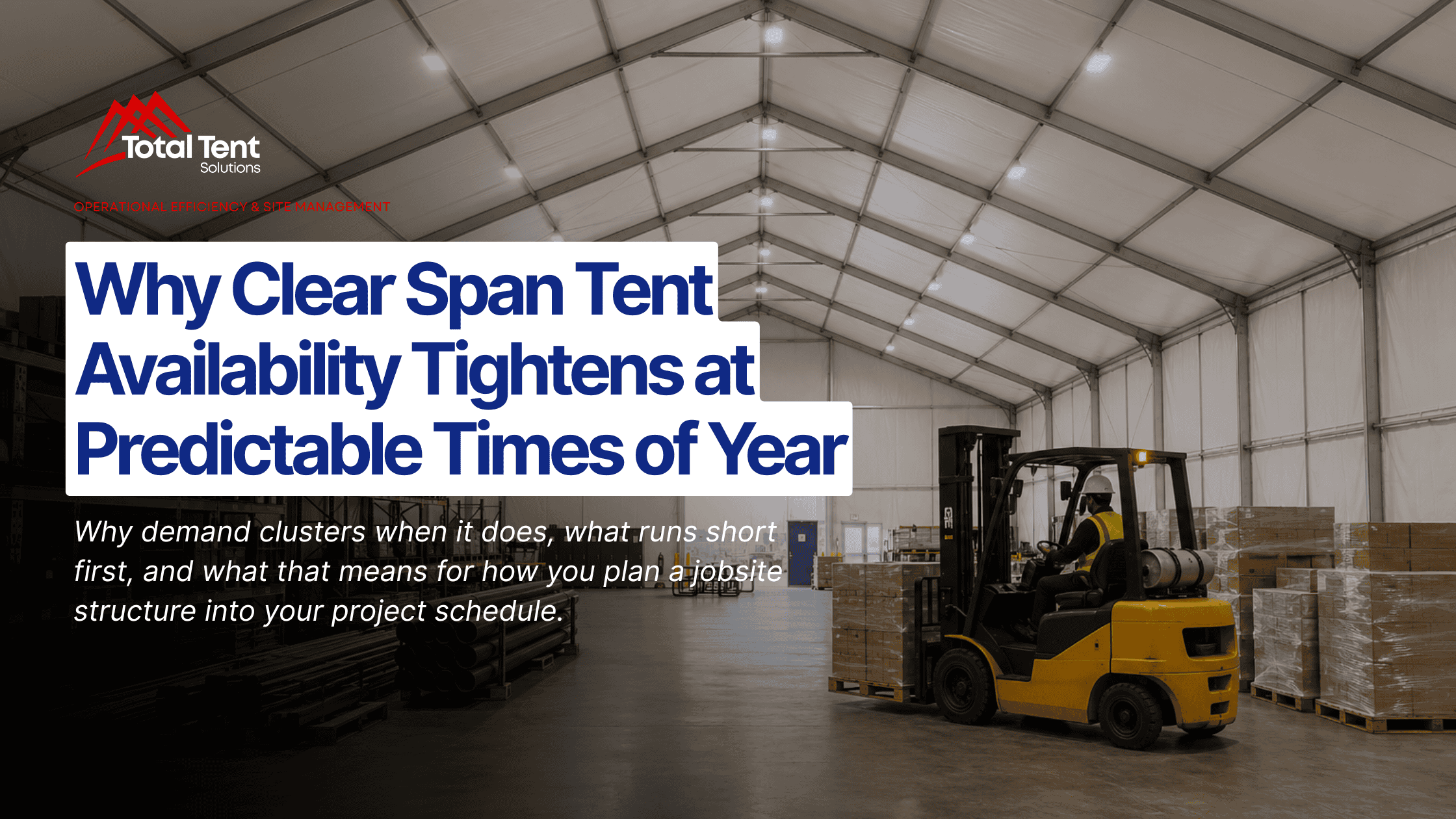
This article breaks down exactly why demand clusters when it does, what runs short first, and what that means for how you plan a jobsite structure into your project schedule.
The Short Answer: Tent Availability Follows Industry Calendars, Not Chance
Clear span structures are not a commodity you can grab off a shelf. They are engineered, code-rated temporary buildings that require design review, site-specific anchoring plans, and trained crews to install correctly. That engineering requirement is exactly why supply cannot flex overnight when demand spikes.
Three separate demand cycles hit at overlapping points in the year: refinery and petrochemical turnaround season, hurricane season on the Gulf Coast, and the general construction industry’s spring and summer ramp-up. When two or three of these line up, and they often do, the pool of available structures, plant-ready crews, and rigging equipment shrinks fast. Add the event industry drawing from a chunk of the same supply base, and you get a market where the smart move is booking months, not weeks, ahead of your mobilization date.
Refinery and Petrochemical Turnaround Season Drives the First Surge
Turnarounds are planned, not spontaneous, but that does not make them predictable to an outsider. Refineries and petrochemical plants do not publish their maintenance calendars. What they cannot hide is the industry-wide pattern behind them.
The Spring Turnaround Window
Most Gulf Coast refineries and petrochemical facilities schedule major maintenance work between late February and May. Plants want the work done before summer gasoline demand peaks, and they want it done in weather that is workable for crews performing outdoor tasks around process units. That combination pulls contractor staging tents, equipment storage structures, and workforce support space onto plant sites in a tight window, all at once, across the same regional footprint.
The Fall Turnaround Window
The second cluster runs from September through November, after summer driving season demand eases and before winter heating demand ramps up. Facilities on three to six year turnaround cycles stagger their individual outages, but the industry as a whole still concentrates activity in this fall window for the same reasons it does in spring: lower product demand and more workable weather for outdoor maintenance and inspection work.
Here is the part that catches contractors off guard. Because no single refinery coordinates its schedule with the plant down the road, you cannot predict tightening by watching one facility. You have to plan around the season, not the schedule of any one client site.
Hurricane Season Creates a Second, Overlapping Squeeze
The Atlantic hurricane season runs June 1 through November 30, with the statistical peak falling between mid-August and mid-October. That window sits almost directly on top of the fall turnaround season, and it adds pressure from two different directions at once.
Pre-Storm Mobilization Pulls Inventory Off the Market
As storm forecasts firm up, industrial sites along the Gulf Coast move fast to secure equipment storage, materials protection, and operational support structures ahead of landfall. That demand does not wait for a normal booking cycle. It compresses weeks of planning into days, and it pulls available inventory and plant-ready crews toward whatever facility is bracing for impact first.
Post-Storm Disaster Relief Competes for the Same Crews
Once a storm makes landfall, demand does not disappear. It shifts. Disaster relief operations, temporary warehouse overflow space, and emergency operational support structures become the priority, often using the same TWIC and HASC certified crews and the same engineered clear span inventory that construction and industrial clients were counting on. If your project timeline runs through peak hurricane season on the Gulf Coast, you are competing with emergency response for the same limited pool.
General Construction Season Adds a Third Layer of Demand
General contractors doing work outside the plant environment face their own seasonal pressure. Spring and summer are the busiest months for construction nationally, driven by longer daylight hours, drier conditions, and the simple fact that owners want exterior work, roofing, and site work done while the weather cooperates.
That means the same months when refineries are turning around units and the Gulf Coast is watching the tropics are also the months when GCs are mobilizing crews, standing up laydown yards, and needing weather protection and crew facilities on active jobsites. Weather delays compound the problem. A rain-soaked week does not just push your schedule back. It pushes your crew facility and materials protection needs back with it, right into a period when everyone else is booking the same equipment.
Event Season Quietly Competes for the Same Supply Chain
Here is a factor that rarely gets mentioned in industrial planning conversations, but it matters. Peak wedding and event season runs from roughly May through October, and it draws heavily on clear span tent inventory, aluminum framing, and fabric membrane supply from manufacturers who serve both the event and industrial markets.
To be clear about what this article is and is not addressing: this is not about backyard party tents, small residential canopies, or single-day event rentals. Total Tent Solutions does not compete in that space, and the structures discussed here are not consumer-grade products. What matters for a GC, EPC contractor, or turnaround coordinator is that the broader manufacturing and fabrication pipeline behind engineered clear span structures serves both markets. When event season peaks at the same time construction and turnaround demand peaks, raw material lead times and fabrication capacity feel it industry-wide, even if your project has nothing to do with weddings or festivals.
What Actually Runs Short First: Structures, Crews, or Equipment
When people say availability “tightens,” they usually mean one specific thing is scarce. In practice, it is rarely just the fabric and frame. Three separate resources run short, often in this order.
Engineered Structures and Fabric Inventory
The physical clear span structures, the aluminum or steel frame components, the flame-retardant membrane, and the accessories like flooring, HVAC, and hard wall systems, all have finite inventory. A provider with a deep stock of structures sized for refinery turnarounds, contractor staging, and warehouse overflow can absorb more simultaneous requests than one running a lean fleet.
TWIC and HASC Certified Installation Crews
This is usually the tighter constraint. Installing an engineered clear span structure at a refinery or petrochemical facility is not the same job as installing one at a construction site outside the plant fence. Plant work requires TWIC-credentialed crews, current HASC safety orientation through Safety Essentials by HASC, and a documented safety record. That pool of plant-ready crews is smaller than the pool of general labor, and it does not grow just because demand spikes.
Installation Equipment and Anchoring Systems
Clear span installations require more than the structure itself. Extended-reach forklifts or telehandlers, manlifts, anchoring or ballast systems, and other installation equipment all have to be available and coordinated with the crew. During peak periods, that equipment can be committed across multiple projects at once, creating another constraint even when the structure itself is available. Some large or unusually complex installations may also require crane support.
What Affects Install Sequencing on Busy Jobsites
Even after a structure and crew are secured, the actual install date on a busy jobsite depends on more than a calendar slot. Several factors determine how quickly a temporary structure goes from delivery to fully operational.
Site Access, Grading, and Anchoring Method
A structure going onto a leveled concrete pad installs differently than one going onto gravel, compacted dirt, or an unlevel surface near active plant operations. Ground conditions determine whether the crew uses ballast blocks, ground anchors, or an engineered foundation system, and each method carries its own setup time. On a congested jobsite, access alone, getting equipment and materials to the actual footprint without crossing an active work zone, can add hours or days to the sequence.
Installation Equipment Coordination With Other Trades
On a busy plant turnaround or construction site, installation equipment has to be coordinated just as carefully as the structure and crew. Extended-reach forklifts or telehandlers, manlifts, and other equipment need clear access to the structure footprint and enough room to operate safely throughout the installation. If other trades are using the same access routes, staging areas, or work zones, the install may have to be sequenced around them. Planning those equipment needs early helps prevent a structure that is ready to install from being delayed by jobsite congestion or competing site activity.
Permitting, Badging, and Plant Safety Orientation
Refinery and petrochemical sites require badging, TWIC verification, and site-specific safety orientation before any crew sets foot past the gate. During peak turnaround periods, plant safety departments are processing a higher volume of contractor badging requests than usual, which can push back your actual start date even if the structure and crew are both ready to go. Municipal permitting adds a separate layer outside the plant fence, where engineered drawings and site plans need review before installation can begin.
Sequencing Multiple Structures on One Site
Large projects rarely need just one structure. A turnaround might need a contractor staging tent, a separate equipment storage structure, and a workforce support space for cooling and break areas, all going up in a specific order tied to when different crews mobilize. Getting that sequence wrong, installing the equipment storage structure before the access route it depends on is clear, for example, creates delays that ripple through the rest of the schedule. Planning install order alongside your broader project schedule, not as an afterthought, is what keeps this from becoming a bottleneck.
How Far Ahead Contractors and Procurement Teams Should Plan
Lead time scales with structure size and site complexity. A smaller structure intended for a short-duration need can sometimes be turned around quickly if inventory allows. A large-format clear span structure, the kind sized for a major turnaround staging area or a multi-week construction mobilization, needs a longer runway because of engineering review, permitting, and crew scheduling.
For plant and refinery sites specifically, add badging and safety orientation lead time on top of the structure and crew booking. If your project falls inside the spring or fall turnaround windows, or anywhere in hurricane season on the Gulf Coast, the safest approach is to start the conversation with your provider as soon as your mobilization date is even roughly known, not once it is locked. Procurement teams that treat temporary structures as a line item to source a few weeks out consistently end up with fewer options and higher costs than teams that build it into the project schedule from the start.
How Total Tent Solutions Plans Around These Cycles
Total Tent Solutions works these cycles from the inside, not around them. Our crews are TWIC-credentialed and carry current HASC safety training, our EMR sits under 1.0, and our structures are engineered to code with BakerRisk blast assessments available per API RP 756 for sites that require them. We staff and stock for the reality of refinery and petrochemical turnaround demand, general construction mobilization, and Gulf Coast hurricane season, because pretending those cycles do not exist does not make them go away.
When a general contractor, EPC firm, or turnaround coordinator calls us, we are not starting from scratch on crew certification or engineering documentation. That groundwork is already done, which is what lets us move faster than a provider building a plan from zero once the request comes in.
Conclusion
Clear span tent availability does not tighten by accident. It tightens because refinery and petrochemical turnaround season, Gulf Coast hurricane season, general construction’s spring and summer ramp-up, and even the event industry’s peak months all draw from an overlapping pool of engineered structures, plant-ready crews, and rigging equipment. Understanding that pattern is the first step. Building it into your project schedule, and working with a provider who already carries the credentials and inventory to move fast, is what actually protects your timeline. If your project touches any part of the calendar we just walked through, the best time to start the conversation is now, not once your mobilization date is a few weeks out.
Frequently Asked Questions
When should a general contractor start requesting quotes ahead of spring turnaround season?
Aim to start conversations with your provider at least sixty to ninety days before your target mobilization date if your project falls between February and May. Plant sites add badging and safety orientation time on top of standard engineering and crew scheduling, so building in that buffer protects against delays you cannot control once the season is underway.
How far in advance should a project book a structure if it overlaps hurricane season?
If any part of your mobilization window falls between June and November, book as early as your project scope allows. Demand during this period is unpredictable because storm-driven mobilization can spike with little notice, pulling inventory and crews away from previously scheduled work. Early booking is the only real hedge against that volatility.
Is availability tighter on the Gulf Coast than in other regions?
Generally, yes, because the Gulf Coast carries the combined weight of refinery and petrochemical turnaround activity and hurricane season in the same geographic footprint. Regions without heavy industrial concentration or hurricane exposure typically see less overlap between demand cycles.
What is the difference between an event tent company and an industrial clear span provider when it comes to availability?
Event tent companies size their inventory and crew certifications around weddings, festivals, and corporate functions. Industrial providers carry TWIC-credentialed crews, plant safety certifications, and engineering documentation built for refinery, petrochemical, and heavy construction sites. During peak season, event-focused inventory is often unavailable for plant work regardless of size, because the crews are not credentialed for site access.
Can a project still get a structure installed on short notice during peak season?
Sometimes, depending on structure size, site conditions, and project requirements. Smaller, less complex installations have a better chance of being accommodated if structure inventory, crews, and installation equipment are available. Large-format structures that require additional engineering, telehandlers or extended-reach forklifts, manlifts, complex anchoring, or plant badging are much harder to compress on short notice. That is why early planning matters most for larger or more complex projects.