
Why Climate Control Matters More Than You Think
A clear span tent can look perfect from the outside, clean lines, wide open interior, plenty of room for crews, equipment, and staging. But if the inside feels like a sauna by midafternoon or a freezer first thing in the morning, the entire plan starts to unravel. Climate control is what turns a temporary structure into a space that can actually support work, schedules, and people.
A good way to think about a tent is like a giant thermos that never quite learned how to self-regulate. Without a proper HVAC strategy, it reacts immediately to outdoor conditions. Sun exposure, wind shifts, humidity, and door traffic all show up inside the space faster than most teams expect. That is why climate control is not a finishing touch, it is foundational.
Comfort Is Productivity
Comfort directly impacts performance on industrial sites. When crews are too hot or too cold, fatigue sets in faster, focus drops, and mistakes become more likely. Climate control quietly protects productivity by keeping the physical environment predictable, allowing crews to work longer, safer, and with better consistency throughout the day.
Equipment, Materials, and Process Protection
Climate control is just as much about protecting what is inside the tent as who is inside it. Tools, materials, electronics, coatings, and staged components can all be damaged by excessive heat, cold, or moisture. Condensation, corrosion, and warping tend to happen quietly, often overnight, and they almost always show up later as delays or rework. Proper HVAC acts like an invisible safeguard that prevents those problems before they start.
Clear Span Tents 101: What Makes Them Different
Clear span tents are popular because they offer wide, column-free interiors that support efficient workflows and flexible layouts. That open volume is a major advantage, but it also changes how air behaves inside the structure.
The Structure Is Only Half the Story
Unlike permanent buildings, tents lack heavy insulation, thermal mass, and airtight construction. They heat up faster, cool down faster, and respond instantly to weather changes. HVAC systems designed for clear span tents must account for this responsiveness. Treating a tent like a scaled-down warehouse almost always leads to comfort issues and higher operating costs.
Common Industrial Use Cases Where HVAC Is Non-Negotiable
Climate control becomes essential when tents are used for turnaround staging, temporary warehouses, fabrication and maintenance zones, crew break areas, safety meeting spaces, or quality control operations. In these environments, stable temperature and airflow are not optional. They directly affect safety, material integrity, and operational efficiency.
HVAC Basics for Temporary Structures
Before selecting equipment, it helps to understand how heating, cooling, and ventilation work together. These functions are related, but they solve different problems.
Heating, Cooling, and Ventilation Explained
Heating adds warmth, cooling removes heat, and ventilation exchanges indoor air with outdoor air. Many temporary setups focus only on heating or cooling and overlook ventilation, which can lead to stagnant air, humidity buildup, and air quality issues. The most effective systems treat HVAC as a complete ecosystem rather than a single piece of equipment.
Balancing Temperature, Airflow, and Moisture
True climate control comes from balancing three elements: temperature regulation, air movement, and moisture control. Ignoring any one of these leads to uneven conditions, discomfort, or long-term damage. A stable tent environment depends on all three working together consistently.
What “Climate Controlled” Really Means on a Job Site
On job sites, the term “climate controlled” is often used loosely. Sometimes it simply means a heater is present. Other times it implies precise temperature and humidity control. Alignment matters. A practical definition is the ability to maintain a consistent temperature range throughout the tent, with sufficient airflow to avoid stagnant zones and enough moisture control to prevent condensation or discomfort.
Choosing the Right System for the Tent and the Task
The right HVAC solution depends on how the tent will be used, how strict the environmental requirements are, and what resources are available on site.
Spot Heating and Portable Units
Spot heating works well when only a small area requires warmth, such as a specific workbench or task zone. It can be cost-effective upfront, but it often leads to uneven temperatures as people and equipment move throughout the space. Portable cooling units face similar challenges in large tents, especially when doors are opening frequently.
Packaged Units both Vertical and Horizontal
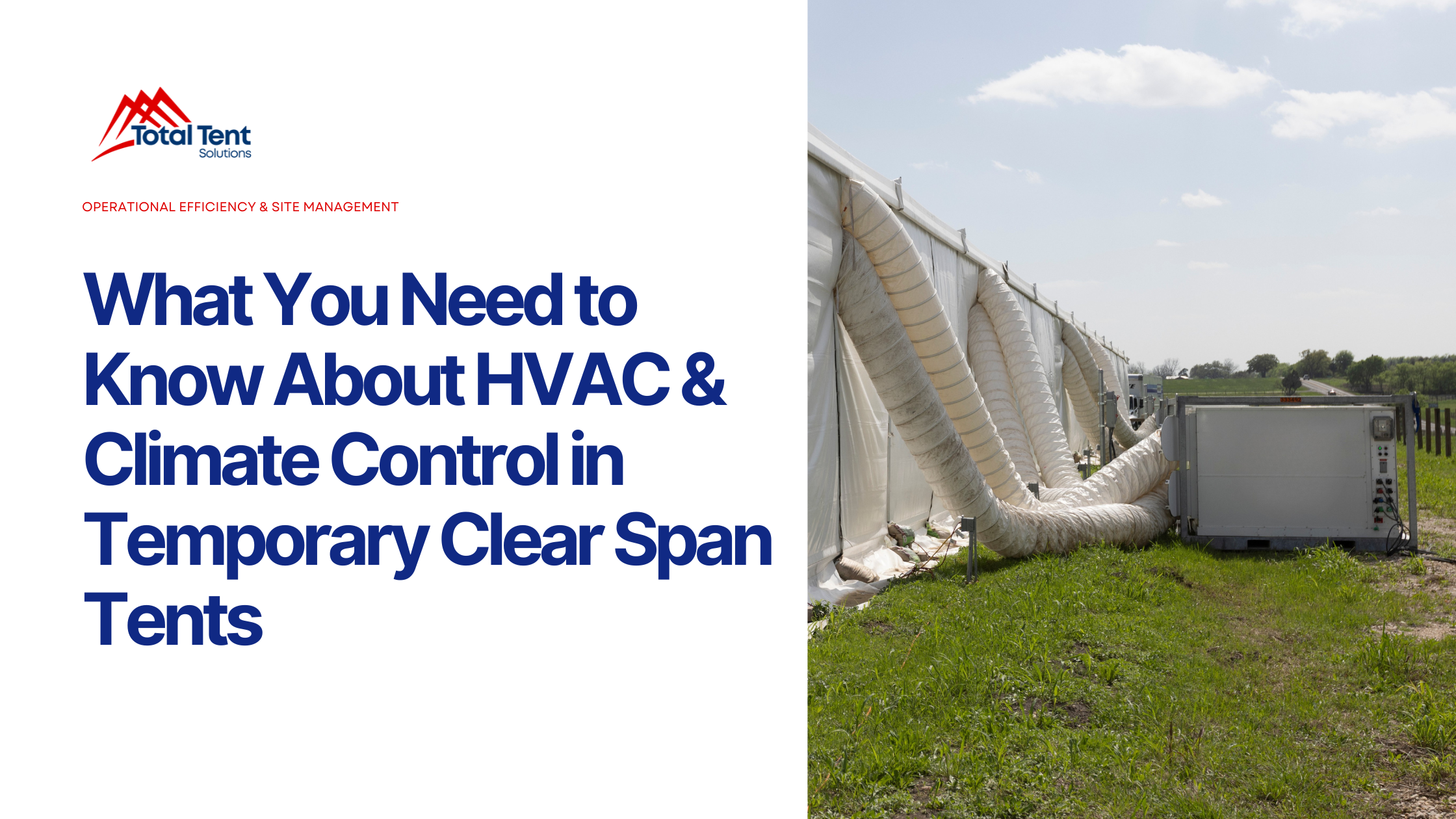
For larger clear span tents, packaged HVAC units provide better capacity and more consistent control. These systems support ducted air distribution, which helps eliminate hot and cold pockets and makes the entire tent feel usable rather than segmented.
Vertical packaged HVAC unit
(Ground-level, exterior-mounted, wall-penetrated)
- Airflow path is vertical (bottom-to-top or top-to-bottom).
- Supply and return openings are stacked vertically.
- Installed on grade outside the tent, adjacent to the wall.
- Duct connections align in a vertical plane at the wall penetration.
- Unit footprint is taller than it is wide or deep.
- Conditioned air enters and exits the tent through stacked wall penetrations.
Horizontal packaged HVAC unit
(Ground-level, exterior-mounted, wall-penetrated)
- Airflow path is horizontal (side-to-side).
- Supply and return openings are side-by-side.
- Installed on grade outside the tent, adjacent to the wall.
- Duct connections align in a horizontal plane at the wall penetration.
- Unit footprint is wider and longer than it is tall.
- Conditioned air enters and exits the tent through side-by-side wall penetrations.
Indirect-Fired vs. Direct-Fired Heating
Indirect-fired heaters separate combustion from the air delivered into the tent, while direct-fired heaters do not. In occupied spaces, indirect-fired systems are often preferred because they deliver clean, dry air and reduce safety risks associated with combustion byproducts.
Why Safety Often Drives the Decision
When crews are working inside a tent for extended periods, or when air quality standards apply, indirect-fired heating is usually the safer and more compliant option. It provides reliable warmth without introducing additional contaminants into the workspace.
Air Distribution: Where Most Setups Succeed or Fail
Air distribution is one of the most overlooked aspects of tent HVAC, yet it has a massive impact on how the space feels.
Designing Airflow That Supports the Space
Air should be delivered evenly across the tent so that work zones receive consistent conditions. Poorly planned ducting can cause air to short-circuit back to the unit or concentrate comfort in one area while leaving others uncomfortable. Thoughtful airflow design allows the system to work efficiently instead of fighting itself.
Why Return Air Matters
Supply air gets most of the attention, but return air is just as important. Without a clear return path, pressure imbalances and drafts develop, and the HVAC system works harder than necessary. Balanced supply and return airflow help stabilize conditions and improve overall performance.
Preventing Hot and Cold Zones
Temperature islands occur when air is not mixed properly. Strategic duct placement, adequate airflow velocity, and intentional mixing prevent these pockets and create a more uniform environment throughout the tent.
Ventilation and Fresh Air Requirements
Ventilation becomes increasingly important as occupancy and activity levels rise.
Protecting Crews and Air Quality
Fresh air exchange maintains oxygen levels and removes contaminants generated by equipment, vehicles, or industrial processes. In many applications, ventilation is a safety requirement rather than a comfort feature, especially when fumes, dust, or vapors are present.
Containment and Pressure Control
Certain maintenance and industrial tasks require negative pressure to prevent contaminants from escaping the tent. These setups rely on controlled exhaust, makeup air, and careful sealing. When designed intentionally, they protect both workers and the surrounding site.
Humidity Control: The Issue That Often Goes Unnoticed
Humidity problems rarely announce themselves early, but they escalate quickly once they appear.
Condensation and Long-Term Damage
When warm, humid air contacts cooler surfaces, condensation forms. In tents, this can lead to dripping ceilings, slippery floors, corrosion, and damaged materials. Over time, uncontrolled moisture quietly undermines safety and equipment reliability.
Managing Moisture Effectively
Humidity control can be achieved through HVAC systems with sufficient latent capacity, supplemental dehumidification, better sealing, and reduced infiltration. Addressing moisture early prevents much larger problems later.
Insulation, Liners, and Fabric Choices That Reduce HVAC Load
The tent envelope plays a meaningful role in HVAC performance, but it does not always need to be upgraded or insulated to achieve workable conditions. In many projects, standard fabric systems paired with properly sized HVAC are more than sufficient. Liners and insulation simply become additional tools when conditions, usage, or efficiency goals call for them.
How Liners Improve Stability
Single-skin tents respond quickly to outdoor temperature changes, which is not necessarily a problem for short-term use, mild climates, or applications with wider temperature tolerances. In situations where tighter control is needed, such as extended winter operations, high-occupancy spaces, or environments with sensitive materials, double-skin systems or insulated liners can help slow heat transfer and stabilize interior conditions.
When used strategically, liners reduce HVAC runtime, smooth out temperature swings, and make the space easier to manage. When they are not necessary, skipping them can reduce setup time and cost without compromising functionality. The key is treating liners as an option based on real operational needs, not as a default requirement.
Doors, Vestibules, and Air Leaks
Doors are the biggest source of air loss. High-traffic tents benefit greatly from vestibules, air curtains, and disciplined door management. Reducing infiltration has an immediate and noticeable impact on comfort and operating costs.
Sizing HVAC for a Clear Span Tent
HVAC sizing is rarely straightforward. Having properly sized HVAC using airflow formulas is a key to proper climate control and HVAC size. Relying on an expert for this calculation is key.
What Actually Drives Load Requirements
Load calculations are influenced by tent volume, ceiling height, climate conditions, sun exposure, internal heat from equipment, occupancy levels, insulation, and how frequently doors are opened. Each factor contributes to how hard the system must work.
Why Square Footage Is Only the Beginning
Two tents with identical square footage can require completely different HVAC systems depending on usage patterns. Understanding how the space will be used is just as important as its size.
Avoiding Costly Sizing Mistakes
Undersized systems struggle constantly, while oversized systems short-cycle and fail to control humidity effectively. Proper sizing balances capacity with control and efficiency.
Power Planning for Temporary HVAC
Reliable power is essential for stable climate control.
Generators and Fuel Logistics
Generators must handle startup loads, continuous runtime, and fuel supply without interruption. Poor power planning leads to unstable temperatures and unnecessary wear on HVAC equipment.
Safe Power Distribution
Temporary power distribution must be weather-protected, properly grounded, and routed safely. HVAC systems rely on consistent power to perform as designed.
Extreme Weather Considerations
Clear span tents can operate in harsh environments, but HVAC strategies must adapt accordingly.
Cold Weather Heating
In winter, sealing, insulation, air mixing, and heater placement all matter. Without proper airflow, warm air rises and escapes while workers remain cold at floor level.
Hot and Humid Conditions
In summer, cooling systems must manage both heat and moisture. Shading, airflow control, and humidity management prevent systems from becoming overwhelmed.
Monitoring and Control
Climate control works best when it is actively monitored.
Sensors and Visibility
Multiple sensors provide a realistic picture of conditions across the tent. Remote monitoring allows teams to respond to issues before they disrupt operations.
Response Planning
Defined alarm thresholds and response procedures turn potential problems into manageable events rather than emergencies.
Safety and Compliance
Temporary does not mean informal.
Combustion and Heater Safety
Heaters must be properly vented, supplied with combustion air, and monitored when required. Carbon monoxide risks must always be addressed.
Noise and Site Flow
Equipment placement should consider noise levels, exhaust direction, and pedestrian routes to avoid creating new hazards.
Cost Drivers and Control Strategies
Climate control costs rise for predictable reasons.
Why Costs Escalate
Poor sealing, constant door openings, lack of insulation, incorrect sizing, and overly tight temperature setpoints all increase runtime and fuel consumption.
Reducing Waste Without Sacrificing Comfort
Improving the envelope, managing airflow, zoning spaces, destratifying air, and monitoring performance all reduce operating costs while maintaining comfort.
Conclusion
HVAC and climate control are what transform a clear span tent from a shelter into a reliable workspace. When temperature, airflow, humidity, power, and monitoring are treated as one integrated system, a temporary structure can perform with the consistency of a permanent building. That reliability protects people, materials, and schedules, which is ultimately what keeps projects moving forward.
FAQs
1. Can clear span tents maintain stable temperatures year-round?
Yes, with proper HVAC design, insulation, and airflow planning, clear span tents can maintain reliable temperature ranges in all seasons.
2. What is the most overlooked aspect of tent climate control?
Air distribution and infiltration control. Even powerful systems struggle without proper airflow management.
3. Is humidity control always necessary?
Not always, but in humid climates or sensitive operations, it becomes critical to prevent condensation and material damage.
4. How can I tell if my HVAC system is undersized?
If the system runs constantly without reaching set-points or conditions vary widely across the tent, capacity or distribution may be insufficient.
5. Are indirect-fired heaters worth the extra cost?
For occupied or air-quality-sensitive environments, they usually are. The added safety and cleaner air often justify the investment.